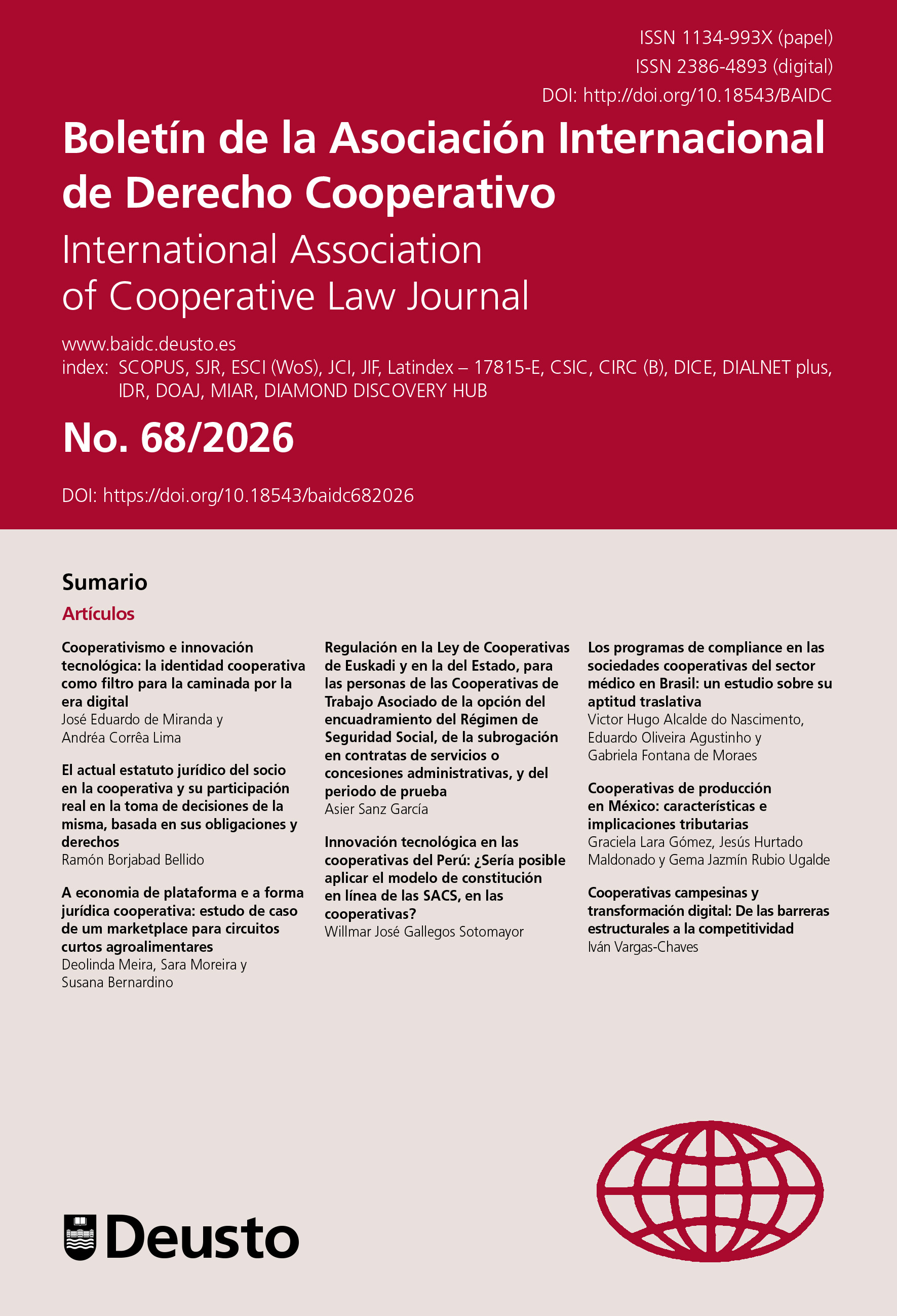
Compliance programs of co-operative societies in the health segment in Brazil: a study about its translative capability
Abstract
This article, adopting a qualitative form and deductive methodology, postulates the adoption of compliance programs by co-operative societies. It argues that these programs enjoy a translative capability, advantageous to translating the risks created by the economy, the multiple objectives pursued by national or private rules and the circumstances of the medical environment. Limiting the research to Brazilian co-operatives which operates in the medical sector, it analyzes the correspondence between the subjects more frequent judged in the national courts and the response given by those co-operative societies. It demonstrates the absence of any conformity. It concludes that the characteristics of these societies represent important achievements considering economic inequality and that compliance programs could promote their permanence.
Received: 19 July 2025; Accepted: 30 March 2025
Downloads
References
ALEXY, Robert. 2015. «Legal certainty and correctedness.» Ratio Juris, 4 ed.
BLACK, Julia. 2002. «Regulatory conversations.» Journal of Law and Society, 1 ed.: 163-196.
BRAITHWAITE, John. 2002. «Rules and principles: a theory of legal certainty.»Australian Journal of Legal Philosophy.
CARBONNIER, Jean. 2006. Droit et passion du droit sous la Ve République. Paris: Flamarion.
FICI, Antonio. 2013. «An introduction to cooperative law.» In International handbook of cooperative law, by Dante Cracogna, Antonio Fici and Hagen Henrÿ. Nueva York: Springer.
FORGIONI, Paula A. 2012. «As sociedades cooperativas no Brasil: muito além dos preconceitos e das questões tributárias.» In Direito Processual Empresarial, by Gilberto Gomes Bruschi. Rio de Janeiro: Elsevier.
FRIEDMAN, Milton A. 1970. «A Friedman Doctrine — The Social Responsibility of business is to increase its profits.» The New York Times, set. 13.
FRISON-ROCHE, Marie-Anne. 2023. «Confronter le rôle du juge et de l»avocat pour imposer la compliance comme caracteristique de l»État de droit.» In La juridictionnalisation de la compliance, by Marie-Anne Frison-Roche. Paris: Dalloz.
FRISON-ROCHE, Marie-Anne. 2019. «Compliance et personnalité. « Recueil Dalloz, 11 ed.
FRISON-ROCHE, Marie-Anne. 2019. «Théorie juridique de la cartographie de risques, centre du droit de la compliance.» Recueil Dalloz, 44 ed.
FRISON-ROCHE, Marie-Anne. 2016. «Le droit de la compliance. « Recueil Dalloz.
GADEA SOLER, Enrique. 2024. «Considerations for the Regulation of a Flexible Type of Co-Operative Society: Co-Operative Values and Principles As Limits to the Autonomous Will of the Members». International Association of Cooperative Law Journal, no. 64 (July), 135-56. https://doi.org/10.18543/baidc.2726.
HENRŸ, Hagen. 2017. «Co-operative principles and co-operative law accross the globe.» In The Oxford Handbook of Mutual, Co-operative, and Co-owned Business, by Jonathan Michie, Joseph R. Blasi and Carlo Borzaga. Nueva York: Oxford University Press.
KAPLOW, Louis. 1992. «Rules versus standards.» Duke Law Journal.
LEGRAND, Pierre. 2022. Negative Comparative Law: A strong programme for weak thought. New York: Cambridge University Press.
MACHADO, Ana Luisa Araújo. 2022. «Os impactos da declaração de taxatividade do rol da ANS pelo STJ no ecossistema da saúde suplementar.» Caderno Virtual, 53 ed.
MILLER, Geoffrey P. 2020. «The compliance function.» In The Oxford hand-book of corporate law and governance, by Jeffrey N. Gordon and Wolf-Georg Ringe. Nueva York: Oxford University Press.
MILLER, Geoffrey P. 2017. The law of governance, risk management, and compliance. 2.
Nueva York: Wolters Kluwer.
PESTOFF, Victor A. 2017. «The social and political dimensions of co-operative enterprises.» In The Oxford Handbook of Mutual, Co-operative, and Co-owned Business, by Jonathan Michie, Joseph R. Blasi and Carlo Borgaza. Nueva York: Oxford University Press.
SAAVEDRA, Gustavo. 2022. «Introdução.» In Compliance, by Gustavo Saavedra. São Paulo: Revista dos Tribunais.
SMITS, Jan. 2015. «Enforcing corporate social responsibility under private law, or: on the disciplining power of legal doctrine.» Masstricht European Private LAw Institute Working Paper, 09 ed.
SULLIVAN, Kathleen M. 1992. «Forward: the justice of rules and standards.» Harvard Law Review.
SUMPTION, Jonathan. 2013. «The limits of the law.» Sultan Azlan Shan Law Lectures.
SUNDFELD, Carlos Ari. 2016. «Compliance: uma reflexão sobre os sistemas de controle nos setores público e privado.» Cadernos FGV Projetos.
TERRA, Aline de Miranda Valverde. 2020. «Planos Privados de assistência à saúde e boa-fé objetiva: natureza do rol de doenças estabelecido pela Agência Nacional de Saúde para fins de cubertura contratual obrigatória.» Revista Brasileira de Direito Civil — RBDCIvil: p. 175-191.
TEUBNER, Gunther. 2016. «Corporate codes in the varieties of capitalism: how their enforcement depends upon difference between production regimes.» Indiana Journal of International Law, 22 ed.
TEUBNER, Gunther. 1998. «Legal irritants: good faith in British Law or how unifying Law ends up in new divergences.» Modern LAw Review: 11-32.

This work is licensed under a Creative Commons Attribution-NonCommercial-NoDerivatives 4.0 International License.
Last update: 29/06/2026
The authors are advised to read their rights carefully. We believe this approach ensures a fair agreement for both parties. These instructions should be read in conjunction with the Ethical Guidelines and the Open Access Policy, Licensing Terms and Copyright of the journal "Boletín de la Asociación Internacional de Derecho Cooperativo (BAIDC)".
1. Authorship and Ethics
By submitting their manuscripts to Boletín de la Asociación Internacional de Derecho Cooperativo (BAIDC), the authors accept and undertake to comply with the conditions of publication without the need to sign an additional transfer agreement with the Publisher (University of Deusto). In doing so, they guarantee that their work is unpublished in any form, original, and does not breach BAIDC’s Ethical Guidelines or the rights of third parties, and that no licences have been or will be granted that are incompatible with the rights granted to the Publisher.
The authors assume full and exclusive responsibility for the content of the study and formally declare that they have no conflicts of interest that affect the integrity of the research.
2. Publisher’s Rights
By submitting the manuscript, the authors agree to its publication under the Creative Commons CC BY-NC-ND 4.0 licence. Consequently, they grant the Publisher the exclusive, royalty-free and worldwide right of first publication, editing, layout and exploitation of the article. This grant authorises the Publisher to distribute, sub-license and index the work in any format, medium, database or institutional repository, for the purposes of promotion and scientific dissemination.
3. Copyright
The authors retain the intellectual property rights to their article and retain the right to distribute and use their work for teaching purposes, future research or personal archiving, provided that the original publication in the Journal is cited. They are also permitted to republish in other media, provided that a (foot)note is included with the full reference to BAIDC (including the DOI, where available) and no explicit endorsement of the Journal and/or Publisher is implied.
4. Open access
BAIDC is an open-access journal; this means that it is freely and fully accessible in its entirety immediately upon publication of its content. However, in accordance with the licence mentioned above, the authors of the articles must always be properly cited; and both commercial use and any modification intended for distribution will require the express prior written permission of the rights holder.
More details are available under the section “Open Access Policy, Licensing Terms and Copyright”.
.jpg)
.jpg)
.jpg)
1.jpg)
.jpg)
.jpg)