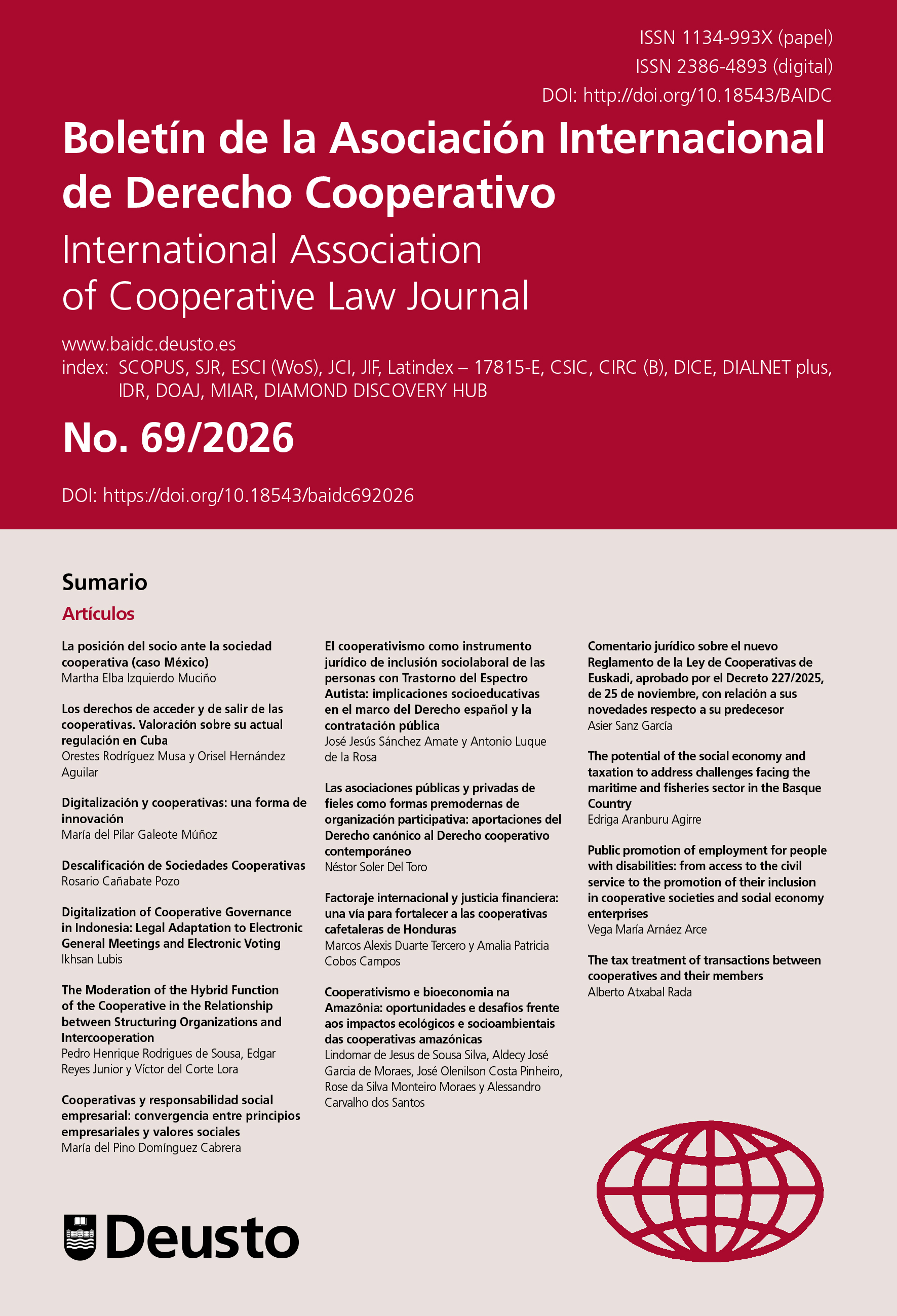
Digitalization of Cooperative Governance in Indonesia: Legal Adaptation to Electronic General Meetings and Electronic Voting
Abstract
This study examines the legal adaptation required for digital cooperative governance in Indonesia, focusing on electronic General Meetings and electronic voting. Using doctrinal legal research, it analyzes the Cooperative Law (Law No. 25 of 1992, as amended in relevant part by Law No. 6 of 2023), the Electronic Information and Transactions Law (Law No. 11 of 2008, as amended by Laws No. 19 of 2016 and No. 1 of 2024), and Government Regulations No. 7 of 2021 and No. 71 of 2019. Indonesian law expressly permits online and offline member meetings, yet lacks integrated procedural standards for authentication, quorum, voting integrity, system reliability, electronic records, and digital inclusion. The article proposes minimum safeguards for secure participation, auditable voting, continuity during system failure, and authenticated electronic minutes to protect democratic member control and the enforceability of cooperative decisions.
Received: 19 February 2026
Accepted: 31 July 2026
Downloads
References
BIERECKI, Dominik. 2021. “Causa of Contracts and General Assemblies Resolutions in Polish Cooperative Law.” Boletín de la Asociación Internacional de Derecho Cooperativo 58: 19-34. https://doi.org/10.18543/baidc-58-2021pp19-34.
BUANG, Mokhtaruddin, and Asnarulkhadi Abu Samah. 2021. “Co-Operative Governance: A Systematic Review of Member Participation.” International Journal of Academic Research in Business and Social Sciences 11 (10): 205-20. https://doi.org/10.6007/IJARBSS/v11-i10/10997.
EMEASOBA, Gabriel Uchechi. 2025. “The Law on Electronic Trade Documents: Applying Functional Equivalence in the Model Law on Electronic Transferable Records and Comparable Common Law Jurisdictions.” Uniform Law Review 30 (3): 314-39. https://doi.org/10.1093/ulr/unaf037.
HAMMER, Anita. 2012. “Institutional Analysis and Collective Mobilization in a Comparative Assessment of Two Cooperatives in India.” In Alternative Work Organizations, edited by Maurizio Atzeni, 157-78. London: Palgrave Macmillan. https://doi.org/10.1057/9781137029041_7.
HENRŸ, Hagen. 2022. “Le Droit Coopératif à La Rencontre de l’identité Coopérative.” Revue de Droit Comparé du Travail et de la Sécurité Sociale 3: 54-63. https://doi.org/10.4000/rdctss.4093.
INDONESIA. 1992. Law No. 25 of 1992 concerning Cooperatives.
INDONESIA. 2008. Law No. 11 of 2008 concerning Electronic Information and Transactions.
INDONESIA. 2016. Law No. 19 of 2016 concerning the Amendment to Law No. 11 of 2008 concerning Electronic Information and Transactions.
INDONESIA. 2019. Government Regulation No. 71 of 2019 concerning the Implementation of Electronic Systems and Transactions.
INDONESIA. 2021. Government Regulation No. 7 of 2021 concerning the Facilitation, Protection, and Empowerment of Cooperatives and Micro, Small, and Medium Enterprises.
INDONESIA. 2023. Law No. 6 of 2023 concerning the Enactment of Government Regulation in Lieu of Law No. 2 of 2022 concerning Job Creation as Law.
INDONESIA. 2024. Law No. 1 of 2024 concerning the Second Amendment to Law No. 11 of 2008 concerning Electronic Information and Transactions.
IZQUIERDO MUCIÑO, Martha E. 2025. “La Digitalización en las Empresas Cooperativas Mexicanas.” Boletín de la Asociación Internacional de Derecho Cooperativo 67: 21-46. https://doi.org/10.18543/baidc.3303.
LAHANGATUBUN, Nurjana, and Andi Muliyono. 2025. “Public Trust and the Legal Validity of Electronic Signatures in Indonesia.” JIHK 7 (1): 499-516. https://doi.org/10.46924/jihk.v7i1.311.
LENHART, Stephanie. 2023. “Lessons from Electric Cooperatives: Evolving Participatory Governance Practices.” In Energy Democracies for Sustainable Futures, edited by Majia Nadesan, Martin J. Pasqualetti, and Jennifer Keahey, 143-49. Academic Press. https://doi.org/10.1016/B978-0-12-822796-1.00015-2.
MEIRA, Deolinda. 2022. “Cooperative Governance and Sustainability: An Analysis According to New Trends in European Cooperative Law.” In Perspectives on Cooperative Law: Festschrift in Honour of Professor Hagen Henrÿ, edited by Willy Tadjudje and Ifigeneia Douvitsa, 223-30. Singapore: Springer. https://doi.org/10.1007/978-981-19-1991-6_21.
MIRIBUNG, Georg. 2020. “Introducing the SCE.” In The Agricultural Cooperative in the Framework of the European Cooperative Society: Discussing and Comparing Issues of Cooperative Governance and Finance in Italy and Austria, 49-84. Cham: Springer. https://doi.org/10.1007/978-3-030-44154-8_2.
MULYAWAN, M. 2023. “Kedudukan Hukum Hasil Rapat Anggota Tahunan Sebagai Dasar dalam Menjalankan Kegiatan Usaha Koperasi (Studi pada Kantor Koperasi Karya Bahari Lombok Utara).” Jurnal Ilmiah Penegakan Hukum 10 (1): 97-112. https://doi.org/10.31289/jiph.v10i1.8683.
NOVKOVIC´, Sonja, and Cian McMahon. 2023. “Humanism and the Cooperative Enterprise: Theoretical Foundations.” In Humanistic Governance in Democratic Organizations: The Cooperative Difference, edited by Sonja Novkovic´, Karen Miner, and Cian McMahon, 17-40. Cham: Palgrave Macmillan. https://doi.org/10.1007/978-3-031-17403-2_2.
PÖNKÄ, Ville. 2018. “The Legal Nature of Cooperative Membership.” The Journal of Entrepreneurial and Organizational Diversity 7 (2): 39-61. https://doi.org/10.5947/jeod.2018.009.
PUUSA, Anu. 2024. “Critical Issues of Co-Operative Governance in Large Co-Operatives: Who Eventually Wields Power?” In The Routledge Handbook of Cooperative Economics and Management, edited by Jerome Nikolai Warren, Lucio Biggiero, Jamin Hübner, and Kemi Ogunyemi, 241- 49. London: Routledge. https://doi.org/10.4324/9781003449850-19.
RATNAWATI, Fajar, and Budhi Santoso. 2024. “Development of a Digital Management System in Cooperatives for Operational Efficiency Improvement.” INOVTEK Polbeng — Seri Informatika 9 (2): 609-18. https://doi.org/10.35314/bdx3zn08.
RODRÍGUEZ GONZÁLEZ, Amalia. 2025. “Instrumentos Normativos para la Constitución de Cooperativas con Medios Tecnológicos.” Boletín de la Asociación Internacional de Derecho Cooperativo 67: 47-97. https://doi.org/10.18543/baidc.3288.
RODRÍGUEZ MUSA, Orestes, and Orisel Hernández Aguilar. 2025. “Las Cooperativas Cubanas ante la Transformación Digital: Realidades y Perspectivas de Conformidad con el Marco Legal Vigente.” Boletín de la Asociación Internacional de Derecho Cooperativo 67: 99-125. https://doi.org/10.18543/baidc.3304.
RUHI, Ahmet Cemal. 2024. “Uluslararası Tahkimde Elektronik Tahkim Kararları ve E-Imza.” Sakarya Üniversitesi Hukuk Fakültesi Dergisi 12 (2): 1063-76. https://doi.org/10.56701/shd.1541316.
SITORUS, Rudolf Hitler Satriawan, and George Frans Wanma. 2024. “The Validity of Electronic Signatures in Electronic Transactions from the Perspective of Regulation Number 71 of 2019.” Eduvest — Journal of Universal Studies 4 (3): 871-79. https://doi.org/10.59188/eduvest.v4i3.1081.
SNAITH, Ian. 2017. “Cooperative Governance.” In Principles of European Cooperative Law: Principles, Commentaries and National Reports, by Gemma Fajardo-García, Antonio Fici, Hagen Henrÿ, David Hiez, Deolinda A. Meira, Hans-H. Muenker, and Ian Snaith, 47-72. Cambridge: Intersentia. https://doi.org/10.1017/9781780686073.004.
STURN, Richard. 2024. “Digital Transformation and Solidarity in Cooperatives.” In Cooperatives in an Uncertain World: Perspectives from Switzerland and Its Neighbors, edited by Michael Ambühl, Stefano Brusoni, Anja Niedworok, and Martin Gutmann, 93-110. Cham: Springer. https://doi.org/10.1007/978-3-031-56200-6_6.
TEXT GENERATED BY CHATGPT, OpenAI, August 1, 2026, https://chat.openai.com/chat.
UNCITRAL. 1996. UNCITRAL Model Law on Electronic Commerce. New York: United Nations. https://uncitral.un.org/en/texts/ecommerce/modellaw/electronic_commerce.
UNCITRAL. 2001. UNCITRAL Model Law on Electronic Signatures. New York: United Nations. https://uncitral.un.org/en/texts/ecommerce/modellaw/electronic_signatures.
VAROGLU, Abdulkadir, Soner Gokten, and Burak Ozdogan. 2021. “Digital Corporate Governance: Inevitable Transformation.” In Financial Ecosystem and Strategy in the Digital Era: Global Approaches and New Opportunities, edited by Umit Hacioglu and Tamer Aksoy, 219-36. Cham: Springer. https://doi.org/10.1007/978-3-030-72624-9_10.
VÁZQUEZ PENA, Manuel José. 2022. “Nuevos mecanismos para facilitar el ejercicio de los derechos de participación en la toma de decisiones en las cooperativas gallegas.” Cooperativismo e Economía Social 43: 315-22. https://doi.org/10.35869/ces.v0i43.3823.
VODENICHAROV, Asen. 2020. “Legal Regulatory Framework of Cooperative Principles.” International Conference KNOWLEDGE-BASED ORGANIZATION 26 (2): 248-54. https://doi.org/10.2478/kbo-2020-0085.
Last update: 29/06/2026
For articles published in issues 34 (2000) through 67 (2025), copyright and exploitation rights belong exclusively to the journal’s publisher, in accordance with the policy in effect at the time of publication. From issue 68 (2026) onwards, the following licensing terms and copyright provisions apply:
The authors are advised to read their rights carefully. We believe this approach ensures a fair agreement for both parties. These instructions should be read in conjunction with the Ethical Guidelines and the Open Access Policy, Licensing Terms and Copyright of the journal "Boletín de la Asociación Internacional de Derecho Cooperativo (BAIDC)".
1. Authorship and Ethics
By submitting their manuscripts to Boletín de la Asociación Internacional de Derecho Cooperativo (BAIDC), the authors accept and undertake to comply with the conditions of publication without the need to sign an additional transfer agreement with the Publisher (University of Deusto). In doing so, they guarantee that their work is unpublished in any form, original, and does not breach BAIDC’s Ethical Guidelines or the rights of third parties, and that no licences have been or will be granted that are incompatible with the rights granted to the Publisher.
The authors assume full and exclusive responsibility for the content of the study and formally declare that they have no conflicts of interest that affect the integrity of the research.
2. Publisher’s Rights
By submitting the manuscript, the authors agree to its publication under the Creative Commons CC BY-NC-ND 4.0 licence. Consequently, they grant the Publisher the exclusive, royalty-free and worldwide right of first publication, editing, layout and exploitation of the article. This grant authorises the Publisher to distribute, sub-license and index the work in any format, medium, database or institutional repository, for the purposes of promotion and scientific dissemination.
3. Copyright
The authors retain the intellectual property rights to their article and retain the right to distribute and use their work for teaching purposes, future research or personal archiving, provided that the original publication in the Journal is cited. They are also permitted to republish in other media, provided that a (foot)note is included with the full reference to BAIDC (including the DOI, where available) and no explicit endorsement of the Journal and/or Publisher is implied.
4. Open access
BAIDC is an open-access journal; this means that it is freely and fully accessible in its entirety immediately upon publication of its content. However, in accordance with the licence mentioned above, the authors of the articles must always be properly cited; and both commercial use and any modification intended for distribution will require the express prior written permission of the rights holder.
More details are available under the section “Open Access Policy, Licensing Terms and Copyright”.