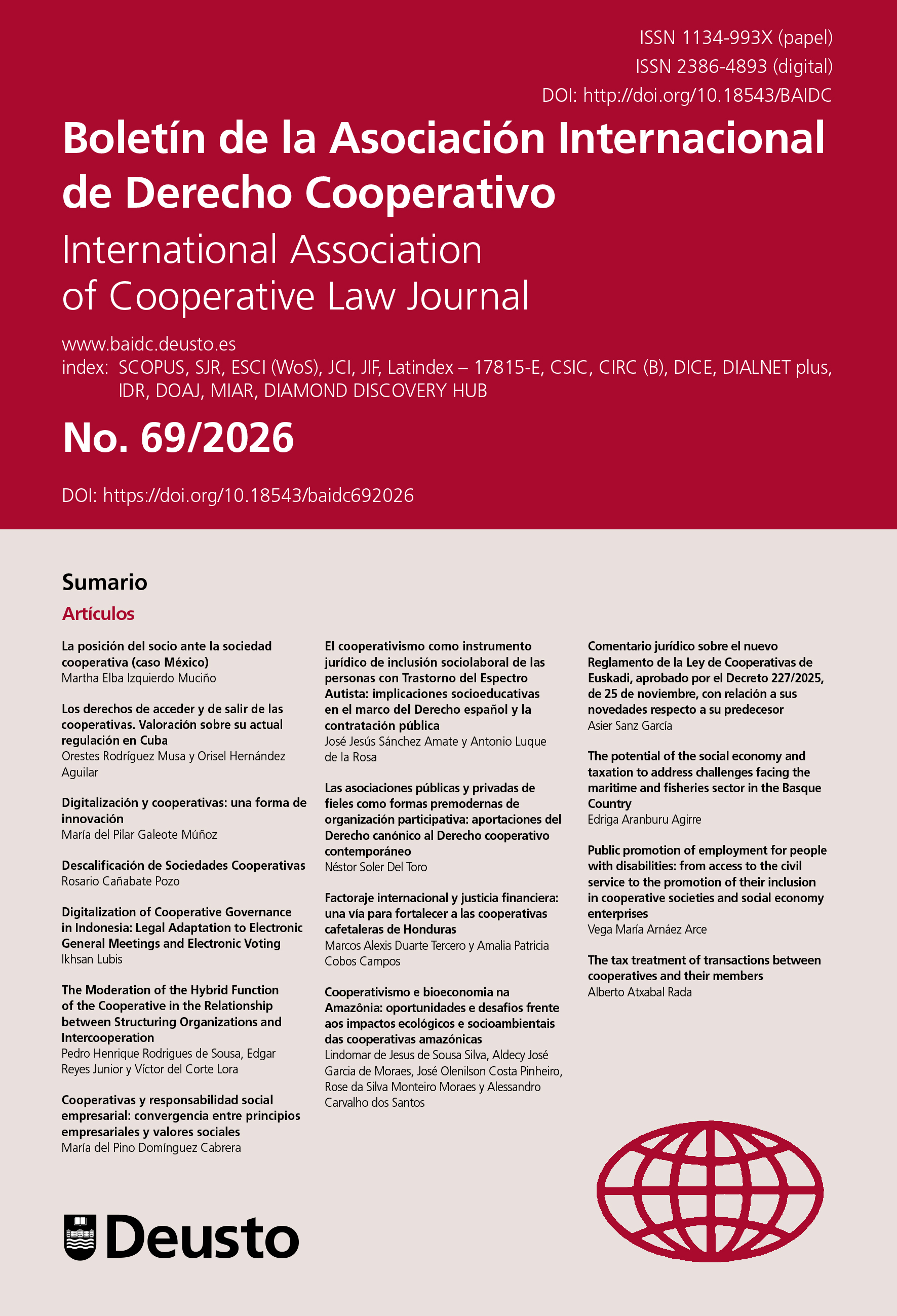
International factoring and financial justice: a way to strengthen coffee cooperatives in Honduras
Abstract
This article focuses on Social Economic Law from the perspective of the legal entities that derive from it, particularly cooperative societies. It addresses this through an analysis of coffee cooperatives in Honduras and their feasibility of adopting international factoring as an autonomous commercial contract capable of strengthening their liquidity and competitiveness, enabling them to access better international market conditions and, consequently, improve the quality of life of the members of these legal entities, whose development is restricted by the country's outdated commercial practices. The article also examines the current regulatory limitations in Honduras, comparing them with other countries that have adequate regulations for this practice, such as France and Mexico. Finally, it highlights the legal and operational principles that should be incorporated into any potential regulatory reform to harmonize Honduran legislation with international standards, promoting financial inclusion and the sustainability of coffee cooperatives within global value chains.
Received: 18 March 2026
Accepted: 3 August 2026
Downloads
References
ALAMILLA LOZANO, Norma, y Verónica Fernanda García Arteaga. 2025. Factoraje Financiero. Apuntes de Clase. Pachuca: Instituto de Ciencias Económico Administrativas, Universidad Autónoma del Estado de Hidalgo.
ARDÓN, Aurora. 2009. «La legislación cooperativa en Honduras».
ARREDONDO CERVANTES, Leonardo. 2014. «El fomento de las Micro, Pequeñas y Medianas Empresas en América Latina: Avances y lecciones aprendidas». Estudios del Desarrollo Social: Cuba y América Latina 2 (2): 1-14.
AZÚA CEDEÑO, Andrés David, y Mónica Patricia Larrea Paredes. 2019. «El Factoring internacional como instrumento financiero para mejorar la competitividad de empresas exportadoras». Revista Científica Ecociencia, Edición Especial: 1-22.
BANCO INTERAMERICANO DE DESARROLLO (BID). 2023. Financing Tools for SMEs in Latin America. Washington, D.C.: BID.
BANQUE DE FRANCE. 2024. Rapport sur l’affacturage et la régulation financière. París: Banque de France.
BARRERA GRAF, Jorge. 1983. Temas de Derecho Mercantil. México: Instituto de Investigaciones Jurídicas, UNAM.
CALVO, Gregory, Marie Bakker, y Leora Klapper. 2024. Factoring and SME Finance in Emerging Markets. Washington, D.C.: World Bank.
CARDONA ARANGO, Aldo A. 1979. Las cooperativas en Honduras. 2.ª ed. Tegucigalpa: Instituto de Investigación y Formación Cooperativa.
CHANG LÓPEZ, Roberto Enrique. 2017. «Análisis de la cadena de valor del sector cafetalero en Honduras». Revista Centroamericana de Administración Pública, n.º 72: 148-160.
COMISIÓN NACIONAL BANCARIA Y DE VALORES (CNBV). 2024. Informe sobre operaciones de factoraje financiero en México. Ciudad de México: CNBV.
CONDE TORCAL, Álvaro. 2014. «El principio de transparencia en la contratación pública». Trabajo de grado, Universidad Pontificia Comillas.
DANCI, Jordan. 2010. «Legal Principles, Legal Values and Legal Norms: Are They the Same or Different?». Academicus International Scientific Journal 1 (2): 109-115. https://doi.org/10.7336/academicus.2010.02.11.
DÁVALOS TORRES, María Susana. 2010. Manual de introducción al Derecho Mercantil. Colección Café Cultura Jurídica. México: Instituto de Investigaciones Jurídicas, UNAM.
DE LA CUESTA RUTE, José María, y Eduardo Núñez Rodríguez. 2007. «Sobre la autorregulación de la publicidad y la competencia mercantil». Comunicaciones en Propiedad Industrial y Derecho de la Competencia, n.º 45: 95-128.
DÍAZ BRAVO, Arturo, y Ana Isabel Ávila Velásquez. 2017. Contratos mercantiles. 11.ª ed. Colección Textos Jurídicos. México: IURE Editores.
DWORKIN, Ronald. 1984. Los derechos en serio. Madrid: Bosch.
FACTORS CHAIN INTERNATIONAL (FCI). 2024. Global Factoring Annual Report. Ámsterdam: FCI.
FERNÁNDEZ S., María Eugenia. 2006. «Las cooperativas: Organizaciones de la economía social e instrumentos de participación ciudadana». Revista de Ciencias Sociales (Ve) 12 (2): 237-253.
FLORES RUIZ, José. 2018. El factoraje internacional y su regulación en América Latina. México: Editorial Jurídica.
FRANCO ALONSO, Pablo Andrés. 2025. «Factoraje financiero a través de fideicomisos públicos, implicaciones fiscales y de liquidez con PYMES en el sector automotriz en Aguascalientes». Trabajo de grado, Universidad Autónoma de Aguascalientes.
FORBES STAFF. 2024. «Crisis cafetera: Emergencia climática y costos elevan los precios y desafían a productores». Forbes Centroamérica, 13 de diciembre de 2024.
GONZÁLEZ ROGEL, José Elías, y Guillermo Pérez Elizundia. 2022. «Factoraje». Nota técnica de Dirección Financiera. Ciudad de México: IPADE Business School, Sociedad Panamericana de Estudios Empresariales.
GUILARTE BARINAGA, Elizabeth, y Luis Augusto Chávez Maza. 2023. «Actualidad de la cooperativa y su identidad: Análisis teórico y práctico». COODES 11 (1): e560.
HERRERA, Luis. 2021. «El sistema de los cuatro factores en el factoraje internacional». Revista de Derecho Mercantil Internacional 15 (2): 45-67.
HUICI GARCÍA, Jimena, y Raquel Georgina Sánchez Lampón. 1997. «El factoraje financiero como medio de financiamiento para las empresas mexicanas». Tesis de licenciatura, Universidad Nacional Autónoma de México.
INSTITUTO HONDUREÑO DEL CAFÉ (IHCAFE). 2023. Informe anual sobre el sector cafetalero hondureño. Tegucigalpa: IHCAFE.
INTERNATIONAL CHAMBER OF COMMERCE (ICC). 2023. Uniform Rules for International Factoring. París: ICC.
INTERNATIONAL FINANCE CORPORATION (IFC). 2024. Knowledge Guide on Factoring Regulation and Supervision. Washington, D.C.: World Bank Group.
KEYENCE. S.F. «¿Qué es la trazabilidad?». Keyence México. Consultado el 15 de marzo de 2026. https://www.keyence.com.mx/ss/products/marking/traceability/basic_about.jsp.
KOBEH SOLÍS, María Guadalupe. 2019. «La actividad empresarial en México». Revista Derecho & Opinión Ciudadana 3 (5): 207-232.
LEÓN TOVAR, Soyla H. 2016. Contratos Mercantiles. 2.ª ed. Textos Jurídicos Universitarios. México: Oxford University Press.
LÓPEZ CARRASCO, Carlos Eduardo, y Haydée Ochoa Henríquez. 2002. «Políticas subnacionales de fomento a la economía social en Venezuela». Revista de Ciencias Sociales (Ve) 8 (3): 417-432.
MOLTONI, Luciana A., y Andrés F. Moltoni. 2015. «Trazabilidad: El rol de la información en el marco del nuevo paradigma de la calidad». Agroalimentaria 21 (40): 79-96.
PALACIOS GONZÁLEZ, Dolores. 2017. «La protección del contratante débil en los contratos en los que no interviene un consumidor». Revista Internacional Consinter de Direito, n.º 5: 395-416.
PÉREZ LUÑO, Antonio Enrique. 2011. Los derechos fundamentales. 10.ª ed. Madrid: Tecnos.
PROGRAMA DE LAS NACIONES UNIDAS PARA EL DESARROLLO (PNUD). 2019. Informe sobre el café y desarrollo rural en Honduras. Tegucigalpa: PNUD.
RODRÍGUEZ, Ana. 2022. «Limitaciones normativas del sistema financiero hondureño frente al factoraje internacional». Revista Centroamericana de Derecho Mercantil 12 (1): 89-110.
RUBEN, Ruerd, Néstor Meneses, Tommie Ponsioen, y Paul Sfez. 2018. Análisis integral de la cadena de valor de café en Honduras. Informe Final. Tegucigalpa: Servicio Holandés de Cooperación al Desarrollo (SNV).
SÁNCHEZ ÁLVAREZ, María Mercedes. 2004. «Grupo de empresas y el concurso de acreedores». En Comentarios a la Ley Concursal, coordinado por Luis Fernández de la Gándara y María Mercedes Sánchez Álvarez, 737- 770. Madrid: Marcial Pons.
SANDOVAL LÓPEZ, Ricardo. 2003. Contratos Mercantiles. Vol. 1. Santiago de Chile: Editorial Jurídica de Chile. SCHOPF OLEA, Adrián. 2018. «La buena fe contractual como norma jurídica». Revista Chilena de Derecho Privado, n.º 31: 109-153.
SECRETARÍA DE ECONOMÍA, Instituto Nacional de la Economía Social, y Unidad de Impulso Productivo (SE/INAES/UIP). s.f. Diagnóstico del programa de fomento a la economía social. Anexo 1: Aproximación general al origen y evolución histórica del concepto de Economía Social en México y el mundo. Ciudad de México: SE/INAES.
SUPREMA CORTE DE JUSTICIA DE LA NACIÓN (SCJN). 2015. «Doctrina de los actos propios: Su derivación inmediata y directa del principio general de buena fe». Tesis jurisprudencial 1a./J. 29/2015 (10a.). Gaceta del Semanario Judicial de la Federación, Libro 17, Tomo II (abril): 1487.
UNIDROIT. 1988. Convention on International Factoring. Roma: UNIDROIT.
WITKER, Jorge. 2022. «El derecho económico como derecho social». En Aportes de Sergio García Ramírez al derecho social, coordinado por Pedro Salazar Ugarte, María Elisa Franco Martín del Campo y Guillermo Raúl Zepeda Lecuona, 3:153-168. México: Instituto de Investigaciones Jurídicas, UNAM.
Last update: 29/06/2026
For articles published in issues 34 (2000) through 67 (2025), copyright and exploitation rights belong exclusively to the journal’s publisher, in accordance with the policy in effect at the time of publication. From issue 68 (2026) onwards, the following licensing terms and copyright provisions apply:
The authors are advised to read their rights carefully. We believe this approach ensures a fair agreement for both parties. These instructions should be read in conjunction with the Ethical Guidelines and the Open Access Policy, Licensing Terms and Copyright of the journal "Boletín de la Asociación Internacional de Derecho Cooperativo (BAIDC)".
1. Authorship and Ethics
By submitting their manuscripts to Boletín de la Asociación Internacional de Derecho Cooperativo (BAIDC), the authors accept and undertake to comply with the conditions of publication without the need to sign an additional transfer agreement with the Publisher (University of Deusto). In doing so, they guarantee that their work is unpublished in any form, original, and does not breach BAIDC’s Ethical Guidelines or the rights of third parties, and that no licences have been or will be granted that are incompatible with the rights granted to the Publisher.
The authors assume full and exclusive responsibility for the content of the study and formally declare that they have no conflicts of interest that affect the integrity of the research.
2. Publisher’s Rights
By submitting the manuscript, the authors agree to its publication under the Creative Commons CC BY-NC-ND 4.0 licence. Consequently, they grant the Publisher the exclusive, royalty-free and worldwide right of first publication, editing, layout and exploitation of the article. This grant authorises the Publisher to distribute, sub-license and index the work in any format, medium, database or institutional repository, for the purposes of promotion and scientific dissemination.
3. Copyright
The authors retain the intellectual property rights to their article and retain the right to distribute and use their work for teaching purposes, future research or personal archiving, provided that the original publication in the Journal is cited. They are also permitted to republish in other media, provided that a (foot)note is included with the full reference to BAIDC (including the DOI, where available) and no explicit endorsement of the Journal and/or Publisher is implied.
4. Open access
BAIDC is an open-access journal; this means that it is freely and fully accessible in its entirety immediately upon publication of its content. However, in accordance with the licence mentioned above, the authors of the articles must always be properly cited; and both commercial use and any modification intended for distribution will require the express prior written permission of the rights holder.
More details are available under the section “Open Access Policy, Licensing Terms and Copyright”.