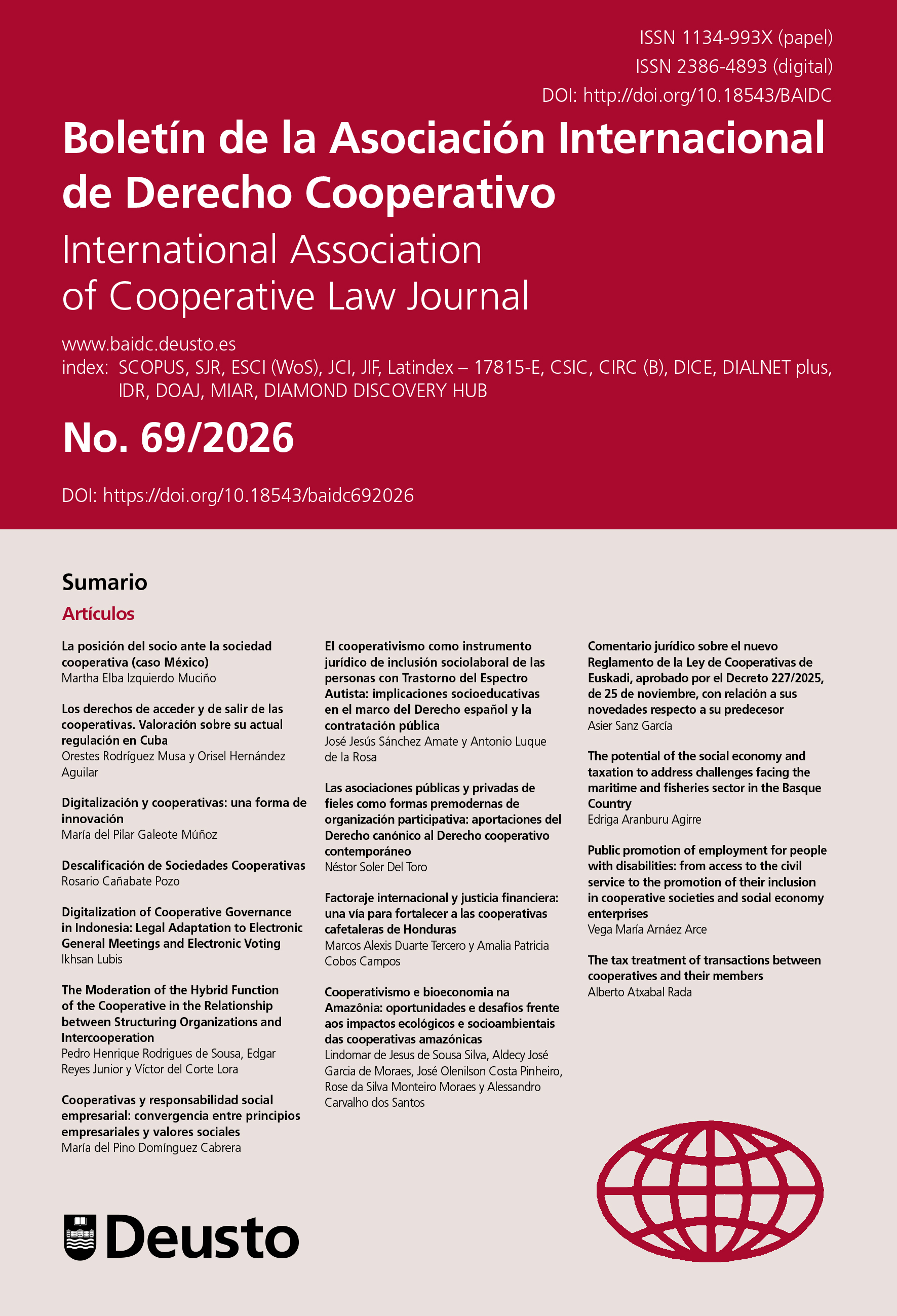
The potential of the social economy and taxation to address challenges facing the maritime and fisheries sector in the Basque Country
Abstract
This article analyses the roles of the social economy and taxation as drivers of a just ecological transition in the maritime and fisheries sector in the Basque Country. The paper examines the current state of the sector and its regulatory framework, from international guidelines to the powers granted by special legal provisions (norma/decreto foral) under the Basque Economic Agreement, paying particular attention to the social dimension. Finally, it identifies challenges and opportunities for fully integrating the social economy into the economic, social and environmental development of the territory, thus contributing to a sustainable ecological transition.
Received: 21 May 2026
Accepted: 10 August 2026
Downloads
References
AGUILAR, M. and VARGAS, C. 2024. Los Principios cooperativos y su incidencia en el régimen legal y fiscal de las cooperativas: Dykinson.
ALDECOA, M.P. 1998. “Las cooperativas del mar y su relación con las cofradías de pescadores”. Anuario de Estudios Comparativos de la Universidad de Deusto, n.º 1: 183-212.
ALIANZA COOPERATIVA INTERNACIONAL. 2006. “La Declaración de la Alianza Cooperativa Internacional sobre la identidad cooperativa: un informe”. Anuario de Estudios Cooperativos, n.º 35.
ARANBURU, E. 2024. “La fiscalidad adecuada como herramienta impulsora de la creación de las sociedades cooperativas en el sector de la pesca y la acuicultura”. Boletín de la Asociación Internacional de Derecho Cooperativo, n.º 65 (diciembre), 325-40. https://doi.org/10.18543/baidc.3070.
ARRIETA IDIAKEZ, F. J.; MARTÍNEZ ETXEBERRIA, G., and LÓPEZ RODRÍGUEZ, J. 2021. “Las Cofradías de Pescadores en Euskadi como entidades de la economía social”. GIZAEKOA — Revista Vasca De Economía Social, n.º 18: 109-133.
BERKES, F. 2009. “Evolution of co-management: role of knowledge generation, bridging organisations and social learning”. Journal of Environmental Management, n.º 90(5):1692-1702.
BONO, E. 2012. “El decrecimiento sostenible, crisis ecológico-económica, desigualdad y economía social”, CIRIEC-España, Revista de Economía Pública, Social y Cooperativa, n.º 76: 180-196.
CERVERA, Á. 2010. La dimensión empresarial de las sociedades cooperativas del mar: Universidad de Cádiz.
CHAVES ÁVILA, R. and MONZÓN CAMPOS, J. L., 2012. The social economy in the European Union: Report drawn up for the European Economic and Social Committee by the International Centre of Research and Information on the Public, Social and Cooperative Economy (CIRIEC). European Economic and Social Committee: Yi, I.
COMISIÓN EUROPEA. 2021. Fondo Europeo Marítimo de Pesca y Acuicultura (FEMPA) 2021-2027.
COMITÉ ECONÓMICO Y SOCIAL EUROPEO. 2022. Economía social: una herramienta clave para el futuro de Europa: CESE.
CORAGGIO, J. 2011. Economía Social y Solidaria. El trabajo antes que el capital: Ediciones Abya-Yala.
DUQUE, P.; MEZA, O. E.; GIRALDO, D.; and BARRETO, K. 2021. “Economía Social y Economía Solidaria: un análisis bibliométrico y revisión de literatura”. REVESCO. Revista de Estudios Cooperativos, n.º 138.
ENCISO, M.; BENGOETXEA, A.; URIARTE, L. 2021. Relato sobre la economía social en el País Vasco. Madrid: Dykinson.
FAO. 2024. El estado mundial de la pesca y la acuicultura 2024. La transformación azul en acción, FAO.
GARCÍA, E. 2009. “El papel de las cofradías de pescadores de Galicia en la consecución de los Objetivos de Desarrollo Sostenible: protección de los recursos marinos y equidad”. CIRIEC, Revista De Economía Pública, Social y Cooperativa, n.º 102: 97-122.
BASQUE GOVERNMENT. 2021. Plan Estratégico de Pesca y Acuicultura de Euskadi 2021-2027. Departamento de Desarrollo Económico, Sostenibilidad y Medio Ambiente.
GÓMEZ, A.M. 2017. La economía social y solidaria en la pesca artesanal y el reto del desarrollo sostenible: el caso de la cofradía de pescadores de Gandía, Cátedra Tierra Ciudadana.
GUZMÁN, B.V.; MENDOZA, J.; and PÉREZ, M.V. 2020. “El valor social y las cofradías canarias: una aproximación a través del análisis de un caso”. CIRIEC-España, Revista de Economía Pública, Social y Cooperativa, n.º 100: 115-153.
HERNÁNDEZ, S.; SÁNCHEZ, M.E.; and SEGADO, I. 2021. “El papel de la gobernanza de la pesca en el logro de los Objetivos de Desarrollo Sostenible: un estudio exploratorio desde las imágenes de los agentes de interés en la Región de Murcia”. Boletín de la Asociación de Geógrafos Españoles, n.º 88.
IGNATIUS, S.; HAAPASAARI, P. 2018. “Justification theory for the analysis of the socio-cultural value of fish and fisheries: The case of Baltic salmon”. Marine Policy, vol. 88: 167-173.
IZQUIERDO, X.; TORRES, F.J. 2019. “Capítulo XXI. Cooperativas del mar”. In: AAVV, Tratado de Derecho de Sociedades Cooperativas, vol. 2 (Coord. Vázquez Ruano, T.; Dir. Peinado Gracía, J.I.), 2.ª ed., Valencia: Tirant Lo Blanch: 1579-1589.
JORGE VÁZQUEZ, J., ALBARRÁN FERNÁNDEZ, C., and SALINAS RAMOS, F. 2013. “La Economía Social ante el nuevo paradigma de Bienestar social”. CIRIEC-España, Revista de Economía Pública, Social y Cooperativa, n.º 79: 5-34.
MALDONADO NIÑO, L.G. 2024. “La economía circular en los procesos productivos: una fuente de sostenibilidad para crear valor en el sector pesquero”. European Public & Social Innovation Review, n.º 9: 1-22.
MEIRA, Deolinda, Sara MOREIRA, y Susana BERNARDINO. 2026. “A economia de plataforma e a forma jurídica cooperativa: estudo de caso de um marketplace para circuitos curtos agroalimentares”. Boletín de la Asociación Internacional de Derecho Cooperativo, n.º 68 (junio), 75-101. https://doi.org/10.18543/baidc.3406.
MINISTRY OF AGRICULTURE, FISHERIES AND FOOD. 2022. Guía de aplicación de la Ley de Pesca Marítima del Estado. Madrid: Secretaría General de Pesca.
MINISTRY OF AGRICULTURE, FISHERIES AND FOOD. 2023. Marco Normativo Fiscal y Laboral en el sector Pesquero Español. Madrid: Centro de Publicaciones del Ministerio de Agricultura, Pesca y Alimentación. Available at: https://www.mapa.gob.es/es/ministerio/servicios/analisis-y-rospectiva/marconormativofiscal2023_lineaactualizado28septiembresindisposicio-nirpf_tcm30-656921.pdf
PÉREZ, F.J.T. 2023. “Apuntes sobre la economía social en el sector pesquero: breve referencia a la fórmula cooperativa”. Revista del Ministerio de Trabajo y Economía Social, n.º 157: 227-242.
PIKETTY, T. 2025. Hacia un socialismo ecológico. Crónicas 2020-2024: Ariel.
TAYLOR-GOOBY, P. 2004. New Risks. New Welfare. The Transformation of the European welfare state: Oxford University Press.
UTTING, P. 2015. Social and Solidarity Economy: Beyond the Fringe: Utting.
VELA-MICOULAUD, G. 2024. “La cooperación entre la Economía social y la Empresa convencional en las políticas de la Unión Europea: oportunidad para ampliar el acceso de la Economía social a los mercados”. Revista Iberoamericana de Economía Solidaria e Innovación Socioecológica, n.º 7: 203-221.
WORLD COMMISSION ON ENVIRONMENT AND DEVELOPMENT. 1987. Our Common Future. Oxford: Oxford University Press.
Last update: 29/06/2026
For articles published in issues 34 (2000) through 67 (2025), copyright and exploitation rights belong exclusively to the journal’s publisher, in accordance with the policy in effect at the time of publication. From issue 68 (2026) onwards, the following licensing terms and copyright provisions apply:
The authors are advised to read their rights carefully. We believe this approach ensures a fair agreement for both parties. These instructions should be read in conjunction with the Ethical Guidelines and the Open Access Policy, Licensing Terms and Copyright of the journal "Boletín de la Asociación Internacional de Derecho Cooperativo (BAIDC)".
1. Authorship and Ethics
By submitting their manuscripts to Boletín de la Asociación Internacional de Derecho Cooperativo (BAIDC), the authors accept and undertake to comply with the conditions of publication without the need to sign an additional transfer agreement with the Publisher (University of Deusto). In doing so, they guarantee that their work is unpublished in any form, original, and does not breach BAIDC’s Ethical Guidelines or the rights of third parties, and that no licences have been or will be granted that are incompatible with the rights granted to the Publisher.
The authors assume full and exclusive responsibility for the content of the study and formally declare that they have no conflicts of interest that affect the integrity of the research.
2. Publisher’s Rights
By submitting the manuscript, the authors agree to its publication under the Creative Commons CC BY-NC-ND 4.0 licence. Consequently, they grant the Publisher the exclusive, royalty-free and worldwide right of first publication, editing, layout and exploitation of the article. This grant authorises the Publisher to distribute, sub-license and index the work in any format, medium, database or institutional repository, for the purposes of promotion and scientific dissemination.
3. Copyright
The authors retain the intellectual property rights to their article and retain the right to distribute and use their work for teaching purposes, future research or personal archiving, provided that the original publication in the Journal is cited. They are also permitted to republish in other media, provided that a (foot)note is included with the full reference to BAIDC (including the DOI, where available) and no explicit endorsement of the Journal and/or Publisher is implied.
4. Open access
BAIDC is an open-access journal; this means that it is freely and fully accessible in its entirety immediately upon publication of its content. However, in accordance with the licence mentioned above, the authors of the articles must always be properly cited; and both commercial use and any modification intended for distribution will require the express prior written permission of the rights holder.
More details are available under the section “Open Access Policy, Licensing Terms and Copyright”.