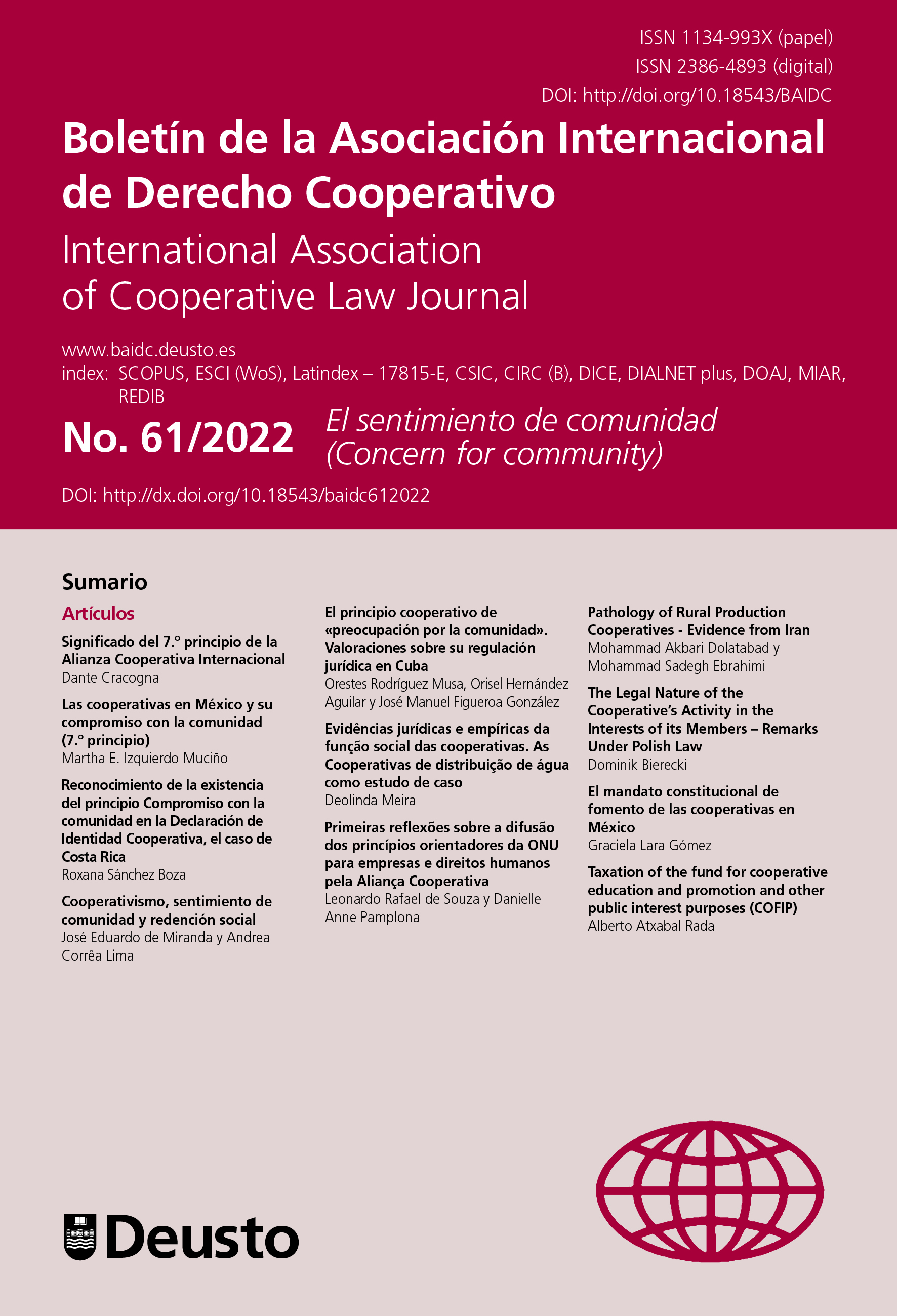
Recognition of the existence of the Principle Concert for Community in the Declaration of Cooperative Identity, the case of Costa Rica
Abstract
The Cooperative Principle has always existed in the life of cooperatives and Costa Rica is no exception, since the legislator through the Education and Social Welfare Committee and the provision of resources to some cooperative institutions has promoted research to determine the scope of this principle. principle beyond the competence of that Committee. In accordance with the decisions and commitments of the International Cooperative Alliance, measurement instruments have been applied to the different cooperative activities, among them is the Social Balance closely related to the Social responsibility of the Company, studies on the contribution to Human Development and on indicators of Social Progress that demonstrate the contribution of cooperatives to the economic and social development of the country.
Received: 01 June 2022
Accepted: 28 October 2022
Downloads
References
AIRTON CARDOSO CANÇADO, María de Fátima Arruda Souza, Ariádne Sclafoni, Rigo, Jeová Torres Silva Junior. 2014. «Principle of “concern for community”: beyond “social responsibility in cooperatives.” Boletín de la Asociación Internacional de Derecho Cooperativo, N.º 48, Bilbao, págs. 191-204.
ALIANZA COOPERATIVA INTERNACIONAL. 2020. Declaración de identidad cooperativa. https://www.ica.coop/sites/default/files/news-item-attachments/25-anniversary-concept-note-final-draft-es-854566612.pdf
ALIANZA COOPERATIVA INTERNACIONAL. 2021. Juventud y cooperativas ¿La pareja perfecta? Informe de una investigación temática global. Equipo editorial Jeffrey Moxom (Alianza Cooperativa Internacional), Simren Singh, (ACI Asia-Pacífico), Melvin Khabenje, (ACI-África), Carlos Enrique González Blanco (Cooperativas de las Américas) John Emerson (Cooperativas Eu- ropa), Dra. Amanda Benson y la Dra. Sarah Alldred (La Universidad Cooperativa).
ARTAVIA, R. 2018. «El movimiento cooperativo en Costa Rica y el progreso social». Revista Horizontes Cooperativos N. 14. Ed. Centro de Estudios y Capacitación Cooperativa R.L, San José- pp. 18 y19.
ASAMBLEA LEGISLATIVA. 1968. Ley N. 1479, Ley de Asociaciones Cooperativas y de creación del INSTITUTO NACIONAL DE FOMENTO COOPERATIVO 1968. Costa Rica. http://www.pgrweb.go.cr/scij/Busqueda/Normativa/Normas/nrm_texto_completo.aspx?nValor1=1&nValor2=32655
BALANCE SOCIAL https://www.aciamericas.coop/Balance-Social-Cooperativo-2394
CASTILLO, Juan y RÍOS, Mayrand. 2021. Ley de Asociaciones Cooperativas y creación del INSTITUTO DE FOMENTO COOPERATIVO. 1.ª ed. San José, C. R.: Instituto de Fomento Cooperativo.
CENTRO DE ESTUDIOS Y CAPACITACIÓN COOPERATIVA R.L. 2017. Estudio de los indicadores de Progreso SOCIAL EN ZONAS DE INCIDENCIA DEL COOPERATIVISMO EN COSTA RICA. Revista Horizontes Cooperativos, N. 23. Ed. CENECOOP R.L. Costa Rica.
COOPEALIANZA R.L. 2019 Informe de gestión. file:///C:/Users/atari/Downloads/ Informe-Gestio%CC%81n-2019.pdf
COOPEASAMBLEA R.L. 2019. file:///E:/7%20PRINC/cOOOP%20aSAMBLEA%20inf-anual-comied%20y-bienestar-soc-2020.pdf
COOPEJUDICIAL R.L. 2018. Reglamento del Comité de educación y Bienestar Social. https://www.coopejudicial.fi.cr/wp-content/uploads/2018/12/R-CA-22-REGLAMENTO-COMITE-DE-EDUCACION-Y-BIENESTAR-SOCIAL-V.6-min.pdf
COOPESANTOS R.L 2018. Informe de rendición de cuentas. https://www.coopesantos.com/wp-content/uploads/2019/03/Informe-de-Rendici%C3%B3n-de-Cuentas-2018.pdf
COOPERSERVIDORES R.L. 2018. Balance social. https://www.coopeservidores.fi.cr/documents/memorias/Reporte%20Anual%20CS%20Grupo%20Financiero2020.pdf
COOPERATIVAS DE LAS AMÉRICAS. Región de la Alianza Cooperativa Internacional. Responsabilidad social cooperativa. https://www.aciamericas.coop/Responsabilidad-social-cooperativa-220
COLÓN MORALES, Rubén. 2021. «El cooperativismo de trabajo visto desde la perspectiva obrera: apuntes para una nueva ley de cooperativismo de trabajo asociado en Puerto Rico». Boletín de la Asociación Internacional de Derecho Cooperativo, n.º 58 (mayo), 59-89. https://doi.org/10.18543/baidc-58-2021pp59-89.
CRACOGNA, Dante. 1992. «Los valores y los principios cooperativos en la ACI. Una visión histórica y actual.» Teoría y práctica de la cooperación. Revista de Idelcoop —Volumen 19— N.º 73, pp. 3-20.
Sétimo Principio cooperativo. En Notas de orientación para los Principios Cooperativos de la Alianza Cooperativa Internacional. 90-104. https://www.aciamericas.coop/IMG/pdf/guidance_notes_es.pdf
EGUÍA, Florencio y MacPherson, Ian. 1997. Identidad Cooperativa. México: Ed. Alianza Cooperativa Internacional.
MUGARRA, Aitzeber. 2003. «Responsabilidad social, balance social y empresa social». Responsabilidad Social de las Empresas y Balance Social, Ed. Universidad Católica de Ávila, España, pp. 137-150
MORILLAS, Francisco Damián. S.a. Responsabilidad social empresarial (RSE) en cooperativas no agropecuarias (CNA) del municipio Centro Habana, en el periodo 2014-2017. Grupo de Creatividad para la Transformación Social. Centro de Investigaciones Psicológicas y Sociológicas. (CIPS). http://biblioteca.clacso.edu.ar/Cuba/cips/20190207052312/03.pdf
SÁNCHEZ, Roxana. 2020. «El impulso ejercicio del Principio de educación, formación e información.» Boletín de la Asociación Internacional de Derecho Cooperativo, Núm. 57. Pp. 39-69. https://doi.org/10.18543/baidc-57-2020
SÁNCHEZ BOZA, Roxana. 2019. «El principio de autonomía e independencia. Consecuencias jurídicas y económicas derivadas de su aplicación en Costa Rica». Boletín de la Asociación Internacional de Derecho Cooperativo, n.º 55 (diciembre), pp. 55-86. https://doi.org/10.18543/baidc-55-2019.
SEGURA, Oscar y CÉSPEDES, Juan Carlos. 2016. Cooperativas y su impacto al desarrollo. reconociendo vías y formas de incidencia. Instituto Nacional de Fomento Cooperativo (INFOCOOP). Centro Dominico de Investigación (CEDI). Costa Rica
STIGLITZ, Joseph. 2017. «El futuro y los desafíos del desarrollo económico para Costa Rica y la región.» Revista Horizontes Cooperativos N.º 23. CENE- COOP R.L. Costa Rica. Pp. 41-61.
Copyright (c) 2022 University of Deusto

This work is licensed under a Creative Commons Attribution-NonCommercial 4.0 International License.
Last update: 29/06/2026
The authors are advised to read their rights carefully. We believe this approach ensures a fair agreement for both parties. These instructions should be read in conjunction with the Ethical Guidelines and the Open Access Policy, Licensing Terms and Copyright of the journal "Boletín de la Asociación Internacional de Derecho Cooperativo (BAIDC)".
1. Authorship and Ethics
By submitting their manuscripts to Boletín de la Asociación Internacional de Derecho Cooperativo (BAIDC), the authors accept and undertake to comply with the conditions of publication without the need to sign an additional transfer agreement with the Publisher (University of Deusto). In doing so, they guarantee that their work is unpublished in any form, original, and does not breach BAIDC’s Ethical Guidelines or the rights of third parties, and that no licences have been or will be granted that are incompatible with the rights granted to the Publisher.
The authors assume full and exclusive responsibility for the content of the study and formally declare that they have no conflicts of interest that affect the integrity of the research.
2. Publisher’s Rights
By submitting the manuscript, the authors agree to its publication under the Creative Commons CC BY-NC-ND 4.0 licence. Consequently, they grant the Publisher the exclusive, royalty-free and worldwide right of first publication, editing, layout and exploitation of the article. This grant authorises the Publisher to distribute, sub-license and index the work in any format, medium, database or institutional repository, for the purposes of promotion and scientific dissemination.
3. Copyright
The authors retain the intellectual property rights to their article and retain the right to distribute and use their work for teaching purposes, future research or personal archiving, provided that the original publication in the Journal is cited. They are also permitted to republish in other media, provided that a (foot)note is included with the full reference to BAIDC (including the DOI, where available) and no explicit endorsement of the Journal and/or Publisher is implied.
4. Open access
BAIDC is an open-access journal; this means that it is freely and fully accessible in its entirety immediately upon publication of its content. However, in accordance with the licence mentioned above, the authors of the articles must always be properly cited; and both commercial use and any modification intended for distribution will require the express prior written permission of the rights holder.
More details are available under the section “Open Access Policy, Licensing Terms and Copyright”.
.jpg)
.jpg)
.jpg)
1.jpg)
.jpg)
.jpg)