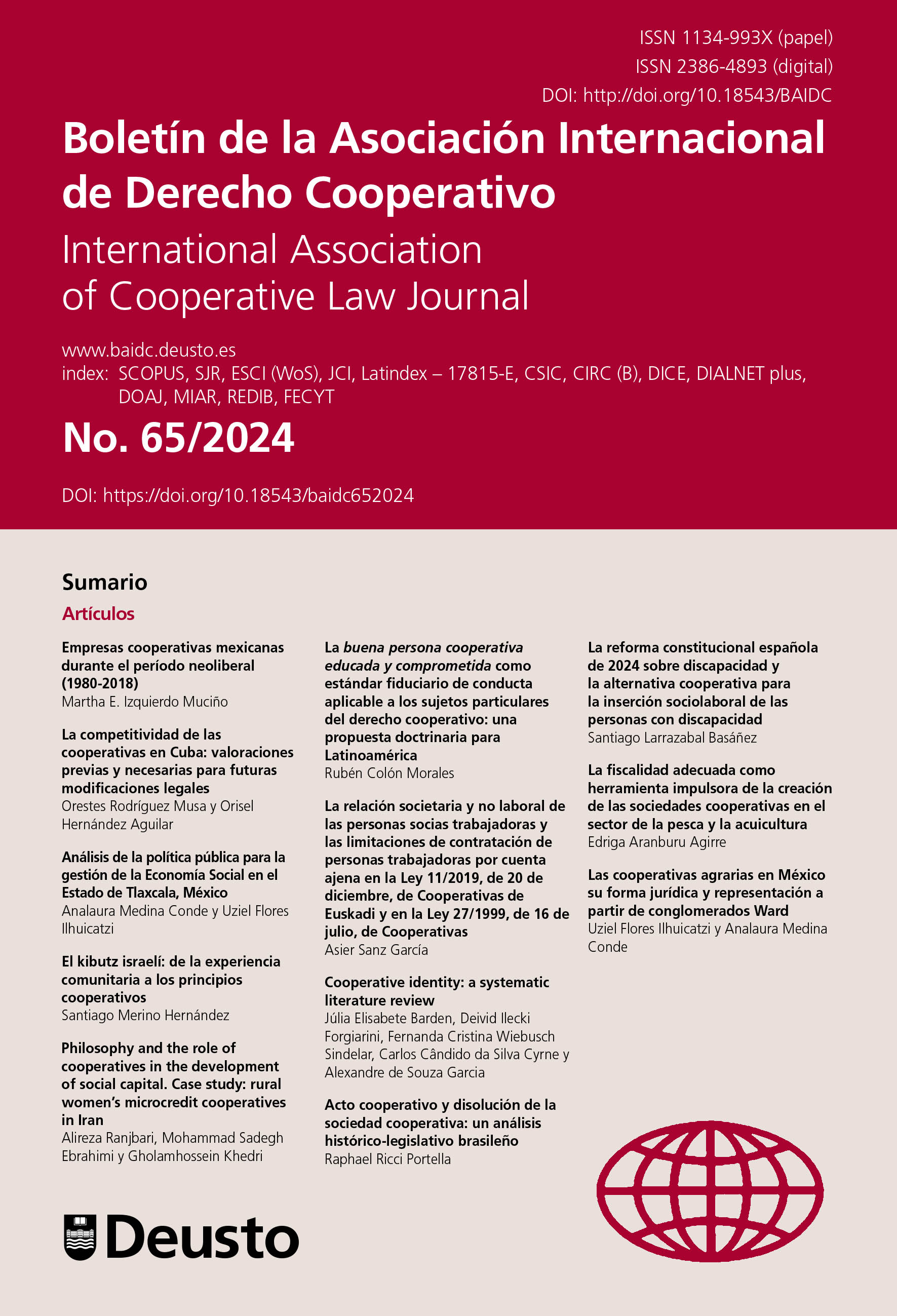
The Spanish constitutional reform of 2024 on disability and the cooperative alternative for the social and labour insertion of people with disabilities
Abstract
The reform of Article 49 of the Spanish Constitution of 1978 in the field of disability has meant an important regulatory change, both in the terminology used and in the conception of the protection of people with disabilities, in order to guarantee their full personal autonomy and social inclusion. And, as we know, cooperatives can play a very relevant role in this respect in the socio-labour field. A joint use of constitutional specialities can be very useful. It would be a matter of building a solid legal basis to justify ‘bold’ measures in this field, combining the effective protection of persons with disabilities in the new Article 49, the constitutional coverage of the differential treatment that can be given to cooperatives by virtue of the constitutional obligation to promote them through appropriate legislation (Article 129. 2), the prohibition of discrimination on grounds of disability (Article 14) and the promotion of positive action measures to achieve real and effective equality (Article 9.2), also provided for in the international human rights treaties and agreements ratified by Spain, which are also a canon for the interpretation of Spanish legislation on fundamental rights and freedoms (Article 10.2).
Received: 31 May 2024
Accepted: 03 October 2024
Downloads
References
ÁLVAREZ GARCÍA, Héctor. 2017. «La tutela constitucional de las personas con discapacidad». Revista de Derecho Político, n.º 100: 1027-1055.
ARENAS ESCRIBANO, Fernando y CABRA DE LUNA, Miguel Ángel. 2015. Comentarios al Texto Refundido de la Ley General de derechos de las personas con discapacidad y de su inclusión social. Madrid: La Ley.
BASTIDA FREIJEDO, Francisco José. 2013. «Constitución, derechos fundamentales y entendimiento constitucional de la discapacidad». En Protección jurídica de las personas y grupos vulnerables, coordinado por Miguel Ángel Presno Linera, 147-183. Oviedo: Universidad de Oviedo / Procuradora General del Principado de Asturias.
BENGOETXEA ALKORTA, Aitor. 2014. «Economía social e inserción laboral de las personas con discapacidad». Revista Vasca de Administración Pública, n.º 99-100: 529-547.
BENGOETXEA ALKORTA, Aitor. 2018. «El empleo de las personas con discapacidad: régimen jurídico básico y algunos apuntes de la problemática latente». En La promoción del emprendimiento y la inserción social desde la economía social. 73-84. Valencia: CIRIEC-España.
CAMPOY CERBERA, Ignacio. 2018. La recepción y aplicación en España de la Convención de Naciones Unidas sobre los derechos de las personas con discapacidad. Murcia: Ed. Laborum.
CAYO PÉREZ BUENO, Luis; De Lorenzo García, Rafael y De Miguel Vijandi, Beatriz. 2016. La Convención Internacional sobre los derechos de las personas con discapacidad 2006-2016, una década de vigencia. Madrid: Cinca.
CAYO PÉREZ BUENO, Luis y De Lorenzo García, Rafael. 2024. La Ley General de derechos de las personas con discapacidad y de su inclusión social (2013-2023). Balance crítico. Pamplona: Editorial Aranzadi.
CERMI (Comité español de representantes de personas con discapacidad). 2018. Objetivos de desarrollo sostenible y promoción de los derechos de las personas con discapacidad. Madrid: Ed. Cinca.
CORDERO GORDILLO, Vanessa. 2011. Igualdad y no discriminación de las personas con discapacidad en el mercado de trabajo. Valencia: Editorial Tirant lo Blanch.
CUENCA GÓMEZ, Patricia. 2018. «Discapacidad y derechos fundamentales». En Derechos Humanos y Constitución, dirigido por Javier de Lucas Martín y José Manuel Rodríguez Uribes, 687-709. Valencia: Editorial Tirant lo Blanch.
DE ASÍS ROIG, Rafael F. 2016. «La Convención internacional de los derechos de las personas con discapacidad como marco de interpretación de los derechos fundamentales de la Constitución española». En La Convención internacional sobre los derechos de las personas con discapacidad 2006-2016, una década de vigencia, coordinado por Luis Cayo Pérez Bueno, Rafael de Lorenzo García y Beatriz de Miguel Vijandi, 129-148. Madrid: Editorial Cinca.
DE ASÍS ROIG, Rafael F. 2017. «Discapacidad y Constitución». Derechos y Libertades. Revista de Filosofía del Derecho y Derechos Humanos, n.º 29: 39-52.
DE ASÍS ROIG, Rafael F. 2020. «De nuevo sobre Constitución y discapacidad». Universitas. Revista de Derecho, Filosofía y Política, n.º 31: 52-64.
DE LORENZO GARCÍA, Rafael y Cayo Pérez Bueno, Luis. 2020. Fundamentos del derecho de la discapacidad. Pamplona: Ed. Aranzadi.
DE LORENZO GARCÍA, Rafael y Cayo Pérez Bueno, Luis. 2021. Nuevas fronteras del derecho de la discapacidad. Pamplona: Ed. Aranzadi.
DIVAR GARTEIZAURRECOA, Javier. 1985. La alternativa cooperativa. Barcelona: Editorial CEAC.
FICI, Antonio. 2015. «La función social de las cooperativas: notas de derecho comparado». REVESCO. Revista de Estudios Cooperativos, n.º 117: 77-98.
GARCÍA ALGUACIL, María José. 2017. Protección jurídica de las personas con discapacidad. Madrid: Editorial Reus.
GARCÍA-CUEVAS ROQUE, Elena. 2023. «Aportaciones de la jurisprudencia constitucional al ámbito de la discapacidad: especial referencia a las SSTCC 3/2018 y 52/2022». Revista General de Derecho Constitucional, n.º 38.
GOBIERNO DE ESPAÑA. 2023. Libro Blanco sobre el empleo y la discapacidad. Madrid: Real Patronato sobre discapacidad.
INFORME OLIVENCIA 2018 sobre la situación general de la discapacidad en España, elaborado por el Observatorio Estatal de la Discapacidad. https://www.observatoriodeladiscapacidad.info/wp-content/uploads/2019/04/OED-INFORME-OLIVENZA-2018.pdf.
LARRAZABAL BASAÑEZ, Santiago. 2019. «Régimen jurídico de la discapacidad y alternativa cooperativa para la inserción laboral de las personas con discapacidad». En Cooperativas y empleo de calidad, dirigido por Francisco Javier Arrieta Idiakez, 61-157. Cizur Menor: Editorial Aranzadi.
LARRAZABAL BASAÑEZ, Santiago, 2020a. «Constitución, reforma constitucional, discapacidad y cooperativas del siglo XXI». En La sociedad cooperativa como instrumento para contribuir a la integración social y laboral, dirigido por Enrique Gadea Soler y Francisco Javier Arrieta Idiakez, 159-198. Madrid: Editorial Dykinson.
LARRAZABAL BASAÑEZ, Santiago. 2020b. «La discriminación por discapacidad en la jurisprudencia del Tribunal Europeo de Derechos Humanos durante la última década (2009-2019)». En Retos del Derecho ante un mundo global, editado por Aitziber Emaldi Cirión y Encarnación La Spina, 903-931. Valencia: Editorial Tirant lo Blanch.
LARRAZABAL BASAÑEZ, Santiago, 2023. «La discapacidad en la jurisprudencia del Tribunal Constitucional y del Tribunal de Justicia de la Unión Europea: ampliar la protección, evitar la discriminación y promover la integración de las personas con discapacidad. Un modelo a seguir: el modelo cooperativo de inclusión laboral». En Las cooperativas como instrumento de política de empleo ante los nuevos retos del mundo del trabajo, dirigido por Francisco Javier Arrieta Idiakez, 63-127. Madrid: Editorial Dykinson.
MILIOS, Georgios. 2022. «El derecho a la no discriminación por motivo de discapacidad». Derechos y Libertades. Revista de Filosofía del Derecho y derechos humanos, n.º 47: 241-271.
MONEREO PÉREZ, José Luis et al. 2021. La protección jurídico-social de las personas con discapacidad. Murcia: Ed. Laborum.
REY MARTÍNEZ, Fernando. 2017. «Igualdad y prohibición de discriminación: de 1978 a 2018». Revista de Derecho Político, n.º 100: 125-171.
SANTERO SÁNCHEZ,ROSA; CASTRO NÚÑEZ, BELÉN y MARTÍNEZ MARTÍN, María Isabel/ GUILLÓ RODRÍGUEZ, Nuria. 2016. «Integración de personas con discapacidad en la economía social. Elementos facilitadores y obstáculos detectados». CIRIEC-España, Revista de Economía pública, social y cooperativa, n.º 88: 29-59.
SERRANO GARCÍA, Ignacio. 2018. Protección jurídica de la persona con discapacidad. Valencia: Editorial Tirant lo Blanch.
Copyright (c) 2024 University of Deusto

This work is licensed under a Creative Commons Attribution-NonCommercial 4.0 International License.
Last update: 29/06/2026
The authors are advised to read their rights carefully. We believe this approach ensures a fair agreement for both parties. These instructions should be read in conjunction with the Ethical Guidelines and the Open Access Policy, Licensing Terms and Copyright of the journal "Boletín de la Asociación Internacional de Derecho Cooperativo (BAIDC)".
1. Authorship and Ethics
By submitting their manuscripts to Boletín de la Asociación Internacional de Derecho Cooperativo (BAIDC), the authors accept and undertake to comply with the conditions of publication without the need to sign an additional transfer agreement with the Publisher (University of Deusto). In doing so, they guarantee that their work is unpublished in any form, original, and does not breach BAIDC’s Ethical Guidelines or the rights of third parties, and that no licences have been or will be granted that are incompatible with the rights granted to the Publisher.
The authors assume full and exclusive responsibility for the content of the study and formally declare that they have no conflicts of interest that affect the integrity of the research.
2. Publisher’s Rights
By submitting the manuscript, the authors agree to its publication under the Creative Commons CC BY-NC-ND 4.0 licence. Consequently, they grant the Publisher the exclusive, royalty-free and worldwide right of first publication, editing, layout and exploitation of the article. This grant authorises the Publisher to distribute, sub-license and index the work in any format, medium, database or institutional repository, for the purposes of promotion and scientific dissemination.
3. Copyright
The authors retain the intellectual property rights to their article and retain the right to distribute and use their work for teaching purposes, future research or personal archiving, provided that the original publication in the Journal is cited. They are also permitted to republish in other media, provided that a (foot)note is included with the full reference to BAIDC (including the DOI, where available) and no explicit endorsement of the Journal and/or Publisher is implied.
4. Open access
BAIDC is an open-access journal; this means that it is freely and fully accessible in its entirety immediately upon publication of its content. However, in accordance with the licence mentioned above, the authors of the articles must always be properly cited; and both commercial use and any modification intended for distribution will require the express prior written permission of the rights holder.
More details are available under the section “Open Access Policy, Licensing Terms and Copyright”.
.jpg)
.jpg)
.jpg)
1.jpg)
.jpg)
.jpg)