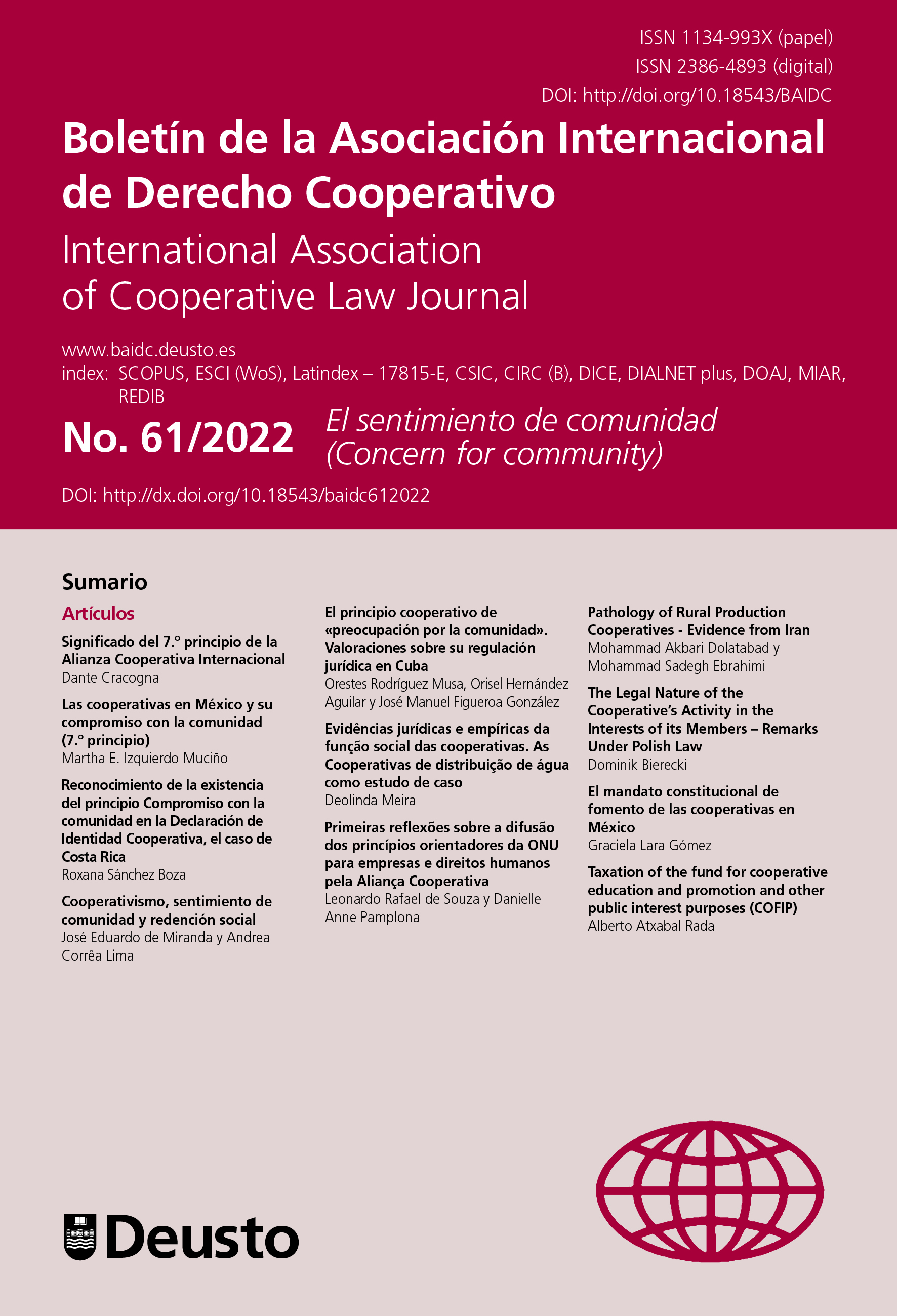
Meaning of the seven principle of the International Cooperative Alliance
Abstract
This paper points out that concern for community is enshrined in the very essence of cooperatives and therefore to consider it as a principle might be regarded as superfluous. Afterwards it makes a survey of the antecedents that gave way to the inclusion of this principle into the Statement of the Cooperative Identity and analyses its interpretation in different documents. A special chapter is devoted to the concern about the environment and the project to modify this principle in order to incorporate within its text this question in an specific way. The article ends considering the treatment of the subject in the Guidance Notes to the Cooperative Principles written by the Principles Committee of the ICA and stating some conclusions about the sense of the principle and its relationship with the increasing relevance of the sustainable development in the recent years.
Received: 06 December 2021
Accepted: 28 October 2022
Downloads
References
ALIANZA COOPERATIVA INTERNACIONAL. 1981. Nuevos enfoques de los principios cooperativos en el mundo, Ediciones Idelcoop, Rosario.
BÖÖK, Sven Ake. 1992. Valores cooperativos para un mundo en cambio, ACI Oficina Regional San José.
CRACOGNA, Dante. 2019. «El principio de autonomía e independencia en la declaración sobre la identidad cooperativa». Boletín de la Asociación Inter- nacional de Derecho Cooperativo, n.º 55 (diciembre), 19-34. https://doi.org/10.18543/baidc-55-2019pp19-34.
CRACOGNA, Dante. 2020. «El principio de educación cooperativa y su recepción legislativa». Boletín de la Asociación Internacional de Derecho Cooperativo, n.º 57 (noviembre), 21-37. https://doi.org/10.18543/baidc-57-2020pp21-37.
ICA. 2015. Guidance Notes to the Co-operative Principles.
GREEN, Pauline. 2015. «Foreword», ICA, Guidance Notes to the Co-operative Principles.
LAIDLAW, Alexander F. 1981. Las cooperativas en el año 2000, Intercoop, Buenos Aires.
LAMBERT, Paul. 1959. La doctrine coopérative, Les Propagateurs de la Coopération, Bruxelles-La Fédération Nationale des Coopératives de Consommation, Paris.
MACPHERSON, Ian. 1995. Co-operative Principles for the 21st Century, ICA, Geneva.
MARCUS, Lars, Cooperativas y valores básicos, El Hogar Obrero, Buenos Aires, s/f.
MÜNKNER, Hans-H. 1995. Chances of Co-operatives in the Future. Contribution to the International Co-operative Alliance Centennial 1895-1995, Ins- titute for Co-operation in Developing Countries, Marburg/Lahn.
THORDARSSON, Bruce. 1996. «Presentación» en ACI, Los principios cooperativos para el Siglo XXI, Intercoop, Buenos Aires.
WATKINS, W.P. 1986. Co-operative Principles Today and Tomorrow, Holyoake Books, Manchester.
Copyright (c) 2022 University of Deusto

This work is licensed under a Creative Commons Attribution-NonCommercial 4.0 International License.
Last update: 29/06/2026
The authors are advised to read their rights carefully. We believe this approach ensures a fair agreement for both parties. These instructions should be read in conjunction with the Ethical Guidelines and the Open Access Policy, Licensing Terms and Copyright of the journal "Boletín de la Asociación Internacional de Derecho Cooperativo (BAIDC)".
1. Authorship and Ethics
By submitting their manuscripts to Boletín de la Asociación Internacional de Derecho Cooperativo (BAIDC), the authors accept and undertake to comply with the conditions of publication without the need to sign an additional transfer agreement with the Publisher (University of Deusto). In doing so, they guarantee that their work is unpublished in any form, original, and does not breach BAIDC’s Ethical Guidelines or the rights of third parties, and that no licences have been or will be granted that are incompatible with the rights granted to the Publisher.
The authors assume full and exclusive responsibility for the content of the study and formally declare that they have no conflicts of interest that affect the integrity of the research.
2. Publisher’s Rights
By submitting the manuscript, the authors agree to its publication under the Creative Commons CC BY-NC-ND 4.0 licence. Consequently, they grant the Publisher the exclusive, royalty-free and worldwide right of first publication, editing, layout and exploitation of the article. This grant authorises the Publisher to distribute, sub-license and index the work in any format, medium, database or institutional repository, for the purposes of promotion and scientific dissemination.
3. Copyright
The authors retain the intellectual property rights to their article and retain the right to distribute and use their work for teaching purposes, future research or personal archiving, provided that the original publication in the Journal is cited. They are also permitted to republish in other media, provided that a (foot)note is included with the full reference to BAIDC (including the DOI, where available) and no explicit endorsement of the Journal and/or Publisher is implied.
4. Open access
BAIDC is an open-access journal; this means that it is freely and fully accessible in its entirety immediately upon publication of its content. However, in accordance with the licence mentioned above, the authors of the articles must always be properly cited; and both commercial use and any modification intended for distribution will require the express prior written permission of the rights holder.
More details are available under the section “Open Access Policy, Licensing Terms and Copyright”.
.jpg)
.jpg)
.jpg)
1.jpg)
.jpg)
.jpg)