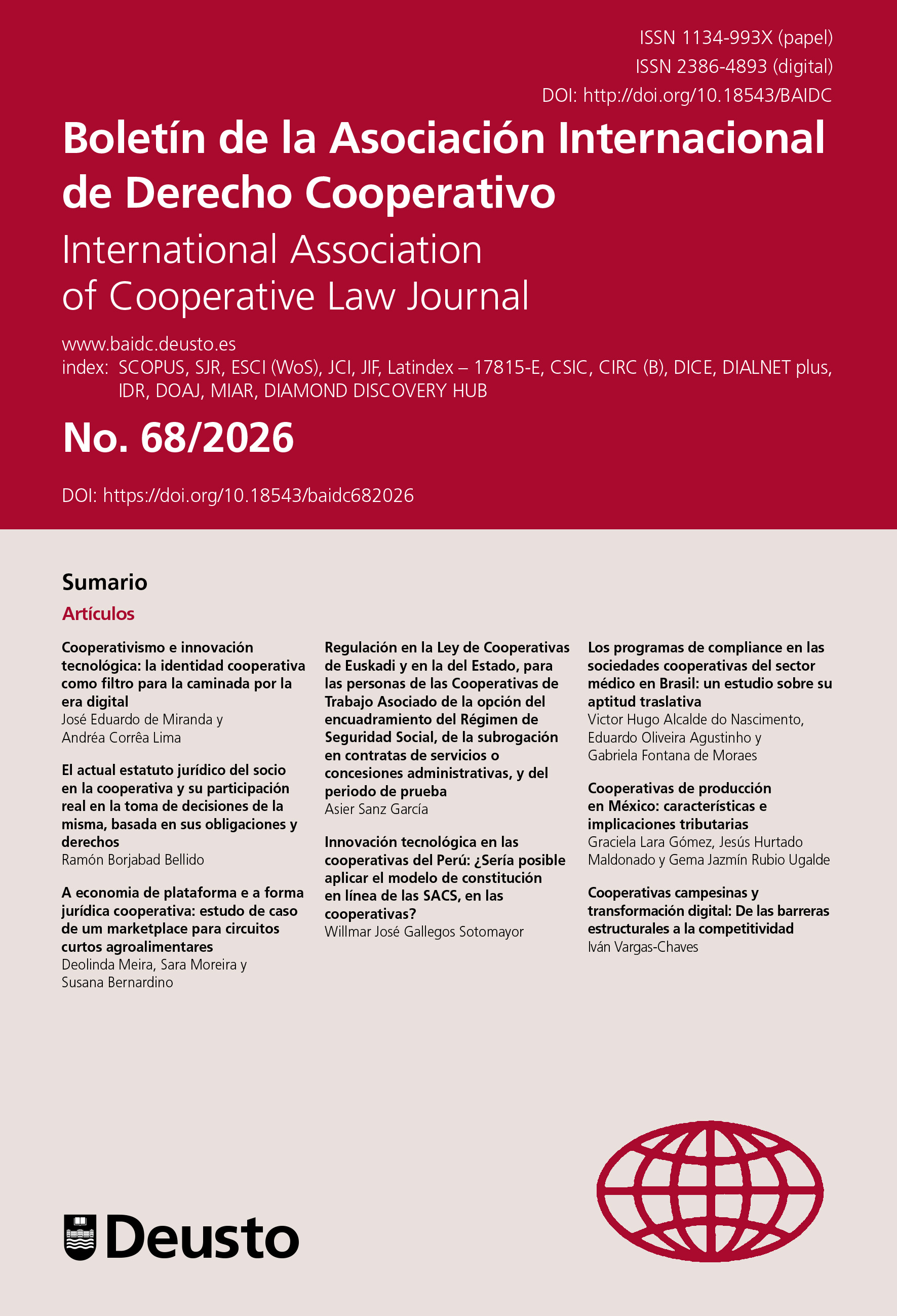
Peasant cooperatives and digital transformation: From structural barriers to competitiveness
Abstract
This study analyzes the regulatory and structural challenges that limit the digital transformation of peasant cooperatives in Colombia, arguing the urgent need for legal reform for their modernization. The research, based on a documentary analysis methodology, reveals that the main barriers are the digital divide, high costs, and an anachronistic legal framework that creates legal uncertainty for digital governance. Despite this, digitalization offers key opportunities to optimize processes and increase transparency. The study concludes that technological modernization is a strategic necessity that requires comprehensive legal reform and public policies that guarantee connectivity and training in the field, to ensure more competitive and equitable rural development.
Received: 15 June 2025; Accepted: 10 April 2025
Downloads
References
ATEHORTUA GONZÁLEZ, Alexander. 2018. «Tecnología e innovación: una apuesta para desarrollar el agro colombiano». Revista Sena 5 (2): 4-5. https://doi.org/10.23850/24220582.1797.
ALMEIDA, Rosa. 2007. «Brecha digital: un problema multidimensional de la sociedad emergente». Inclusão Social 2 (2): 96-108. https://revista.ibict.br/inclusao/article/viewFile/1605/1811.
ARBOLEDA, Carlos., Johana RAMÍREZ, y Mariana RESTREPO. 2020. «Innovación agropecuaria para el desarrollo regional». Administración & Desarrollo 50 (1). https://revistas.esap.edu.co/index.php/admindesarro/article/view/521.
ARCHILA, Aleida, y John BETANCURT. 2015. «La Economía campesina y solidaria: Una ruta para la Paz de Colombia». En Atas CIAIQ2015 3: 204-207. https://proceedings.ciaiq.org/index.php/ciaiq2015/article/view/334.
ARRIETA IDIAKEZ, Francisco Javier. 2019. «Las Cooperativas Digitales Como Canales Para El Trabajo Digital En Un Contexto De economía Colaborativa». Boletín De La Asociación Internacional De Derecho Cooperativo 54: 75-96. https://doi.org/10.18543/baidc-54-2019pp75-96.
ATXABAL RADA, Alberto. 2011. «Incentivos fiscales para la implantación y uso de las tecnologías de la información en las empresas.» En Derecho y nuevas tecnologías, coordinado por Ana Isabel Herrán Ortiz, Aitziber Emaldi Cirión, y Marta Enciso-Santocildes, Vol. 3, 99-114. Bilbao: Universidad de Deusto.
ATXABAL RADA, Alberto. 2020. «Las medidas fiscales para favorecer el em-prendimiento por las cooperativas.» REVESCO: Revista de Estudios Cooperativos, no. 133: 13-20. https://dx.doi.org/10.5209/REVE.67335.
AYAZ MUHAMMAD, Mohammad AMMAD-UDDIN, Zubair SHARIF, Ali MAN-SOUR, y El-Hadi M. AGGOUNE. 2019. «Internet-of-Things (IoT)-based smart agriculture: Toward making the fields talk». IEEE Access 7: 129551-129583. http://doi.org/10.1109/ACCESS.2019.2932609.
BAQUERO-MELO, Jairo. 2017. «Vulnerabilidad socioecológica y socioeconómica en cadenas de valor agrícola. El caso de la producción del plátano en Colombia». Revista Latinoamericana de Estudios Rurales 2 (3): 96-128. http://www.ceil-conicet.gov.ar/ojs/index.php/revistaalasru/article/view/198/114.
BAUTISTA, Sandra. 2016. «Mujer rural y construcción de paz en Colombia: te-mas, problemas y desafíos». Revista Prospectiva 24: 121-148. http://revistaprospectiva.univalle.edu.co/index.php/prospectiva/article/view/4545.
BOTELLO, Héctor, e Isaac GUERRERO. 2017. «Condiciones para el empoderamiento de la mujer rural en Colombia». Entramado 13 (1): 62-70. http://www.scielo.org.co/pdf/entra/v13n1/1900-3803-entra-13-01-00062.pdf.
CÁRDENAS ZAMORA, Belén Alejandra, NÁÑEZ ALONSO, Sergio Luis, MUÑOZ DEL NOGAL, Noelia, SÁNCHEZ SOLANO, Enrique y SALINAS RAMOS, Francisco. 2025. «Barreras a la Inclusión Juvenil y la transformación digital en el Cooperativismo Guatemalteco». REVESCO. Revista de Estudios Cooperativos 151, n.º noviembre: e105454. https://doi.org/10.5209/reve.105454.
CENTENO, Matias. 2016. «Jóvenes y TIC: repensando el agro». Revista Márgenes 13 (18): 17-25.
COMO, Elena, Agnès MATHIS, Marco TOGNETTI y Andrea RAPISARDI. 2016. «Cooperative platforms in European landscape: an exploratory study». ISIRC Working Paper 09/2016: 1-35. https://coopseurope.coop/wp-content/uploads/files/Paper_Cooperatives%20Collab%20Economy__0.pdf.
CRACOGNA, Dante. 2022. «Significado del 7.º principio de la Alianza Cooperativa Internacional». Boletín de la Asociación Internacional de Derecho Cooperativo, n.º 61 (diciembre), 19-33. https://doi.org/10.18543/baidc.2280.
DÁVILA, Ricardo. 1996. «Las cooperativas rurales y el desarrollo regional: el caso de las provincias del sur de Santander, Colombia». Cuadernos de Desarrollo Rural 37: 47-62. https://revistas.javeriana.edu.co/index.php/desa-rrolloRural/article/view/3300.
DÍAZ, Valentina, y J. FERNÁNDEZ. 2017. ¿Qué sabemos de los jóvenes rurales? Síntesis de la situación de los jóvenes rurales en Colombia, Ecuador, México y Perú. Documento de trabajo, n.º 228. Centro Latinoamericano para el Desarrollo Rural. https://www.rimisp.org/wp-content/files_mf/1514474040S%C3%ADntesisdelasituaci%C3%B3nlosj%C3%B-3venesruralesenColombiaEcuadorM%C3%A9xicoyPer%C3%BA281217.pdf.
FAO (Organización de las Naciones Unidas para la Alimentación y la Agricultura). 2012. Las cooperativas agrícolas alimentan al mundo. Roma: FAO.
FLORES ILHUICATZI, Uziel, y Analaura MEDINA CONDE. 2024. «Las cooperativas agrarias en México: su forma jurídica y representación a partir de conglomerados Ward». Boletín de la Asociación Internacional de Derecho Cooperativo, n.º 65 (diciembre), 341-63. https://doi.org/10.18543/baidc.3036GA.
GADEA SOLER, Enrique. 2006. «Cooperativismo y globalización.» Boletín de la Asociación Internacional de Derecho Cooperativo, no. 40: 49-62.
GADEA SOLER, Enrique. 2012. «La función económica de la cooperativa y la necesidad de una legislación adecuada.» REVESCO: revista de estudios cooperativos, no. 108: 39-58.
GADEA SOLER, Enrique. 2020. «Análisis de riesgos y evaluación de impacto relativa a la protección de datos: su aplicación a las sociedades cooperativas.» Boletín de la Asociación Internacional de Derecho Cooperativo, no. 56: 47-72. https://doi.org/10.18543/baidc-56-2020pp47-72.
GIRALDO, Omar. 2010. «Campesinas construyendo la utopía: mujeres, organizaciones y agroindustrias rurales». Cuadernos de Desarrollo Rural 7 (65): 41-57. http://www.scielo.org.co/pdf/cudr/v7n65/v7n65a03.pdf.
GUTIÉRREZ, Juan David. 2014. «Smallholders» Agricultural Cooperatives in Colombia, vehicles for rural development?». Cuadernos de Desarrollo Rural 73: 219-271. https://revistas.uniandes.edu.co/doi/abs/10.13043/dys.73.6.
HERNÁNDEZ SALAZAR, Giovanni Andrés, y Ana María OLAYA PARDO. 2018. «El marco legislativo y su efecto sobre el crecimiento del sector cooperativo en Colombia (1933-2014)». REVESCO, Revista de Estudios Cooperativos 127: 139-158. https://doi.org/10.5209/REVE.58398.
HOINLE, Brigit, Rainer ROTHFUSS, y Damaris GOTTO. 2013. «Empoderamiento espacial de las mujeres desde la economía solidaria». Cuadernos de Desarrollo Rural 72: 117-139. http://www.scielo.org.co/pdf/cudr/v10n72/v10n72a07.pdf.
LIU, Ye, Xiaoyuan MA, Lei SHU, Gerard HANCKE, y Adnan ABU-MAHFOUZ. 2021. From Industry 4.0 to Agriculture 4.0: current status, enabling Technologies, and Research Challenges». IEEE Transactions on Industrial Informatics 17 (6): 4322-4334. http://doi.org/10.1109/TII.2020.3003910.
MONTALVO, Jaider, Oscar BARRIGA, y Susan ROJAS. 2017. «Tecnología aplicada en el agro colombiano: asimetrías evidenciadas en la competitividad entre los subsectores café y maíz durante el periodo 2005-2015». Negocios y Relaciones Internacionales. https://ciencia.lasalle.edu.co/cgi/viewcon-tent.cgi?article=1113&context=negocios_relaciones.
PACHECO ALMARAZ, Victoria, María Isabel PALACIOS RANGEL, Fernando CERVANTES ESCOTO, Jorge OCAMPO LEDESMA, y Jorge AGUILAR ÁVILA. 2019. «La asociación cooperativa como factor de sostenibilidad del sistema cafetalero en comunidades marginadas». REVESCO, Revista de Estudios Cooperativos 131: 125-150. https://doi.org/10.5209/REVE.63563.
PARDO MARTÍNEZ, Luz Patricia, y María Victoria HUERTAS DE MORA. 2017. «Modelos influyentes en las cooperativas de ahorro y crédito en Colombia». REVESCO, Revista de Estudios Cooperativos 125: 109-133. https://doi.org/10.5209/REVE.58134.
PARRADO, Álvaro. 2010. «From the Associative Companies to the Nuclei of Rural Entrepreneurs». Agronomía Colombiana 28 (3): 487-492.
PERFETTI, Juan José. 2009. «Crisis y pobreza rural en América Latina: el caso de Colombia». Documento de Trabajo n.° 43. Programa Dinámicas Territoriales Rurales. Santiago, Chile: Rimisp.
PNUD (Programa de las Naciones Unidas para el Desarrollo). 2011. Colombia rural. Razones para la esperanza. Informe Nacional del Desarrollo Humano. Bogotá: INDH PNUD.
RODRIGUEZ FERNANDEZ, Andrea Carolina y NUVAEZ CASTILLO, José Javier. 2023. «Análisis de las estrategias implementadas desde la economía solidaria para la reactivación económica en el distrito de Santa Marta». Boletín de la Asociación Internacional de Derecho Cooperativo, n.º 62 (julio), 95-107. https://doi.org/10.18543/baidc.2548.
RODRÍGUEZ-VARGAS, Francisco. 1998. «Organizaciones de productores de café en el sector cooperativo». Innovar 11: 39-63.
SALINAS, J., URGILÉS, M. & SASTRE-MERINO, S. 2023. «El capital social de organizaciones productivas rurales de la economía social», CIRIEC-España, Revista de Economía Pública, Social y Cooperativa, 109, 245-284. https://doi.org/10.7203/CIRIEC-E.109.25065.
SANTOS, Santiago y Josef KIENZLE. 2020. «Agriculture 4.0: Agricultural robotics and automated equipment for sustainable crop production». Integrated Crop Management 24: 1-25. http://www.fao.org/sustainable-agricultural-mechanization/resources/publications/details/es/c/1363243/.
SAWANT, Divya, Anchal JAISWAL, Jyoti SINGH, y Payal SHAH. 2019. «AgriBot — An intelligent interactive interface to assist farmers in agricultural activities». Presentado en IEEE Bombay Section Signature Conference (IBSSC), Mumbai, India, 26-28 de julio. http://doi.org/10.1109/IBSSC47189.2019.8973066.
SCHEJTMAN, Alexander. 1980. «Economía campesina: lógica interna, articulación y persistencia». Revista de la CEPAL 11: 121-140. https://repositorio.cepal.org/handle/11362/11934.
SOTO, Paula y María FAWAZ. 2016. «Ser mujer microempresaria en el medio rural». Cuadernos de Desarrollo Rural 13 (77): 141-167. http://www.scielo.org.co/pdf/cudr/v13n77/0122-1450-cudr-13-77-00141.pdf.
SOTOMAYOR, Octavio, Eduardo RAMÍREZ, y Hugo MARTÍNEZ. 2021. «Digitalización y cambio tecnológico en las MIPYMES agrícolas y agroindustriales en América Latina». Boletín CEPAL/ONU/FAO LC/TS.2021/65. Santiago. https://www.cepal.org/es/publicaciones/46965-digitalizacion-cambio-tecnologico-mipymes-agricolas-agroindustriales-america.
SOUSA SILVA, José OLENILSON COSTA PINHEIRO, Endrio MORAIS DOS SANTOS, Jemima Ismael Da COSTA, y Gilmar Antonio MENEGHETTI. 2019. «O cooperativismo como instrumento para a autonomia de comunidades rurais da Amazônia: a experiência dos agricultores extrativistas do municipio de Lábrea, AM». Boletín de la Asociación Internacional de Derecho Cooperativo, 55: 199-226. https://doi.org/10.18543/baidc-55-2019pp199-226.
TOBASURA, Isaías. 2009. «De campesinos a empresarios: la retórica neoliberal de la política agraria en Colombia». Agronomía 17 (1): 21-34.
TRENDOV, Nikola, Samuel VARAS, y Meng ZENG. 2019. Tecnologías digitales en la agricultura y las zonas rurales. Roma: FAO. https://www.fao.org/publications/card/es/c/CA4887ES/.
URIBE, Mauricio. 2012. «Estilos de desarrollo y sesgo anticampesino en Colombia». Cuadernos de Economía 32 (60): 505-535. https://revistas.unal.edu.co/index.php/ceconomia/article/view/40122/42280.
VACCA, Gabriel. 2021. «Tendencias De Las Investigaciones En Innovación Y Marketing Del Sector Agropecuario En Colombia Entre Los Años 2010 Y 2020». Tesis de maestría, Universidad Santo Tomás. https://repository.usta.edu.co/bitstream/handle/11634/37826/2021gabrielvacca.pdf.
VALENTINE, Gill, y Sarah L. HOLLOWAY. 2001. «A window on the wider world? Rural children»s use of information and communication techno logies». Journal of Rural Studies 17 (4): 383-394. https://doi.org/10.1016/S0743-0167(01)00022-5.
VARGAS-CHAVES, Iván, PIRACOCA-CHAVES, Diego y FUENTES-MANCIPE, Mónica. 2024. «Las cooperativas indígenas y el codiseño: oportunidades de competitividad para revitalizar el conocimiento tradicional del Pueblo Wayuú». Boletín de la Asociación Internacional de Derecho Cooperativo, n.º 64 (julio), 157-84. https://doi.org/10.18543/baidc.2831.
VARGAS-CHAVES, Iván. 2023. «Las cooperativas indígenas: entre los derechos a la autonomía y la libre determinación de los pueblos indígenas y su plan de vida». Boletín de la Asociación Internacional de Derecho Cooperativo, n.º 62 (julio), 137-64. https://doi.org/10.18543/baidc.2527.
VARGAS-CHAVES, Iván, Francisco ACEVEDO-CAICEDO, y Eduardo SALGADO-FIGUEROA. 2020. «Las Cooperativas Rurales: Una Oportunidad Para Repensar El Rol Del Estado Frente a Los Impactos De La regulación De Semillas En Colombia». Boletín De La Asociación Internacional De Derecho Cooperativo, 57, 391-408. https://doi.org/10.18543/baidc-57-2020pp391-408.
VARGAS PRIETO, Amanda, y Diana Carolina CASTAÑEDA GUZMÁN. 2019. «Efecto de las cooperativas exportadoras de café en el crecimiento de la economía solidaria en Colombia». REVESCO, Revista de Estudios Cooperativos 130: 213-234. https://doi.org/10.5209/REVE.62810.
VILLAR HERNÁNDEZ AGUILAR, Orisel. 2015. «Algunas reflexiones en torno a la dimensión jurídico-formal del proceso de constitución de cooperativas no agropecuarias en Cuba a partir del análisis del caso del municipio Pinar del Río». Boletín de la Asociación Internacional de Derecho Cooperativo, 49: 279-306. https://doi.org/10.18543/baidc-49-2015pp279-306.
VITÓN, Roberto, Ana CASTILLO, y Tomás LOPES. 2018. AgTech: Mapa de la innovación Agtech en América Latina y el Caribe. Washington, D.C.: Banco Interamericano de Desarrollo. https://doi.org/10.18235/0001788.
YORG, José Alberto, y Ana María RAMÍREZ-ZARZA. 2018. «El derecho cooperativo y el docente cooperativo». Boletín de la Asociación Internacional de Derecho Cooperativo, 53: 169-180. https://doi.org/10.18543/baidc-56-2020pp169-180.
ZULUAGA, Gloria y Carolina ARANGO. 2013. «Mujeres campesinas: resistencia, organización y agroecología en medio del conflicto armado». Cuadernos de Desarrollo Rural 10 (72): 159-180. http://www.scielo.org.co/pdf/cudr/v10n72/v10n72a09.pdf.

This work is licensed under a Creative Commons Attribution-NonCommercial-NoDerivatives 4.0 International License.
Last update: 29/06/2026
The authors are advised to read their rights carefully. We believe this approach ensures a fair agreement for both parties. These instructions should be read in conjunction with the Ethical Guidelines and the Open Access Policy, Licensing Terms and Copyright of the journal "Boletín de la Asociación Internacional de Derecho Cooperativo (BAIDC)".
1. Authorship and Ethics
By submitting their manuscripts to Boletín de la Asociación Internacional de Derecho Cooperativo (BAIDC), the authors accept and undertake to comply with the conditions of publication without the need to sign an additional transfer agreement with the Publisher (University of Deusto). In doing so, they guarantee that their work is unpublished in any form, original, and does not breach BAIDC’s Ethical Guidelines or the rights of third parties, and that no licences have been or will be granted that are incompatible with the rights granted to the Publisher.
The authors assume full and exclusive responsibility for the content of the study and formally declare that they have no conflicts of interest that affect the integrity of the research.
2. Publisher’s Rights
By submitting the manuscript, the authors agree to its publication under the Creative Commons CC BY-NC-ND 4.0 licence. Consequently, they grant the Publisher the exclusive, royalty-free and worldwide right of first publication, editing, layout and exploitation of the article. This grant authorises the Publisher to distribute, sub-license and index the work in any format, medium, database or institutional repository, for the purposes of promotion and scientific dissemination.
3. Copyright
The authors retain the intellectual property rights to their article and retain the right to distribute and use their work for teaching purposes, future research or personal archiving, provided that the original publication in the Journal is cited. They are also permitted to republish in other media, provided that a (foot)note is included with the full reference to BAIDC (including the DOI, where available) and no explicit endorsement of the Journal and/or Publisher is implied.
4. Open access
BAIDC is an open-access journal; this means that it is freely and fully accessible in its entirety immediately upon publication of its content. However, in accordance with the licence mentioned above, the authors of the articles must always be properly cited; and both commercial use and any modification intended for distribution will require the express prior written permission of the rights holder.
More details are available under the section “Open Access Policy, Licensing Terms and Copyright”.
.jpg)
.jpg)
.jpg)
1.jpg)
.jpg)
.jpg)