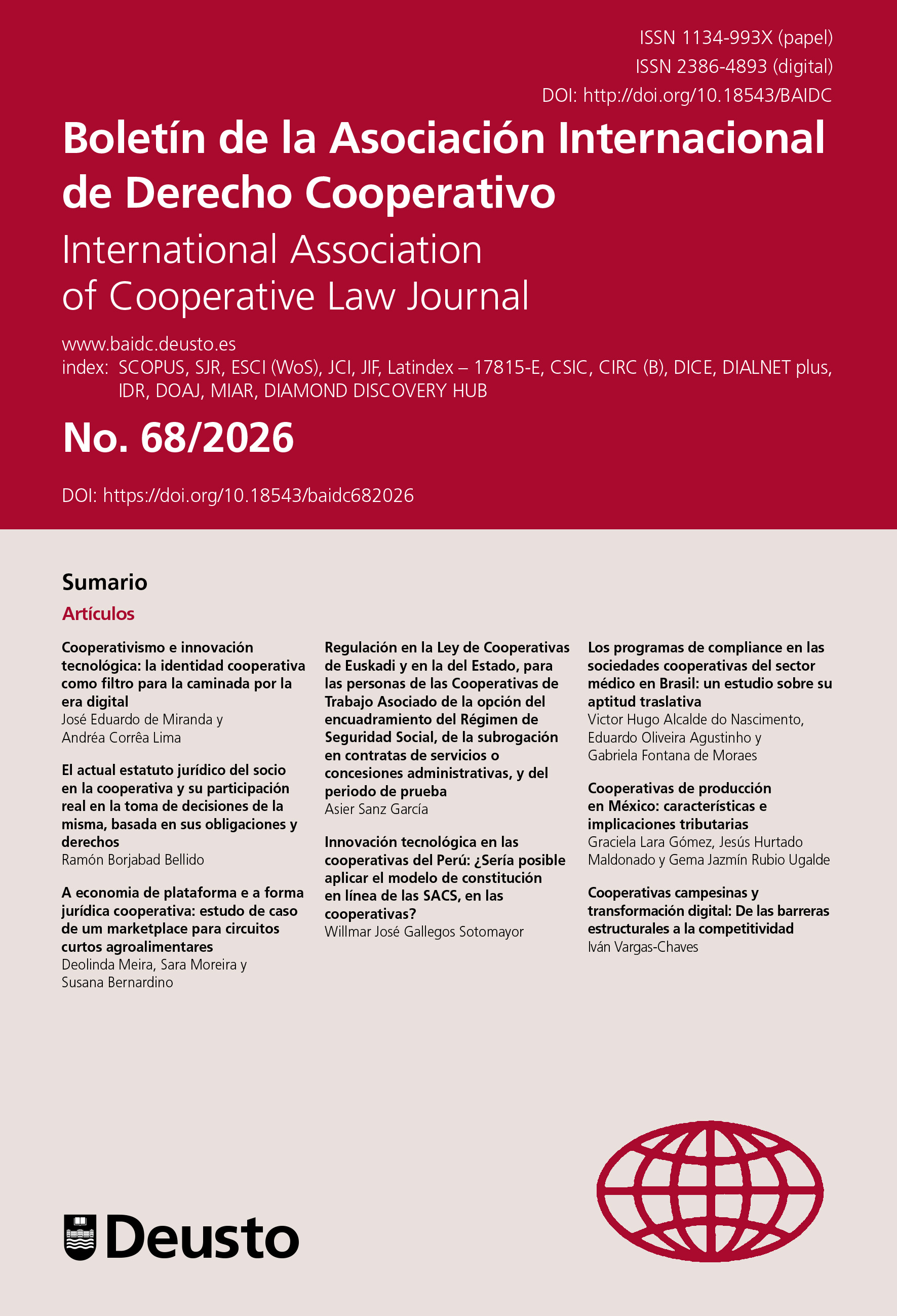
Worker cooperatives in Mexico: characteristics and tax implications
Abstract
Worker cooperatives are a valuable instrument for economic and social development. They are governed by principles and values that prioritize people over capital. Their management is democratic, and their economic logic is primarily based on the labor contributed by their members. Due to their importance, this article aims to establish the implications for worker cooperatives in Mexico when differential treatments are applied regarding Income Tax, which is conditioned upon the performance of certain economic activities. Because of their characteristics, these organizations operate at a disadvantage compared to capitalist enterprises and therefore require a tax treatment that provides income-related incentives. The research employs a systematic method, which examines legal norms in relation to other legal provisions. The results show that, although there are tax incentives for worker cooperatives, these mainly benefit those engaged in agriculture, livestock, fishing, and forestry. In contrast, the rest can only defer tax payments, which affects their ability to fulfill their social purpose.
Received: 14 July 2025; Accepted: 23 March 2026
Downloads
References
CHAMPEIL-DESPLATS, V. 2020. Los métodos de interpretación, sus límites y consecuencias para la investigación. Revista Jurídica de Investigación e Innovación Educativa, 22, pp. 119-134. https://hal.parisnanterre.fr/hal-03562040v1.
CÓDIGO DE COMERCIO (1889). Publicado en el Diario Oficial de la Federación. http://www.memoriapoliticademexico.org/Textos/5RepDictadura/1889CDC.html.
CPEUM (1917). Constitución Política de los Estados Unidos Mexicanos, publicada en el Diario Oficial de la Federación el 5 de febrero de 1917. Última reforma de fecha 15 de abril de 2025.
DOF (2025). Resolución de facilidades administrativas para los contribuyentes de los sectores que en la misma se señalan para 2025. Diario Oficial de la Federación de 17 de febrero de 2025.
HERRANZ H., A. 2024. Cooperativas, libertad y eficiencia. Recerca. Revista de Pensament i Anàlisi, 29(1), pp. 1-24. https://doi.org/10.6035/re-cerca.7619.
INEGI. 2019. Censos Económicos. https://www.inegi.org.mx/programas/ce/2019/.
INEGI. 2025. Economía y sectores productivos. UMA. https://www.inegi.org.mx/temas/uma/.
IZQUIERDO M., M. E. 2020. El cooperativismo mexicano a través de sus leyes. Deusto Estudios Cooperativos, pp. 43-67. ISSN-e: 2255-3452. https://doi.org/10.18543/dec-16-2020pp43-67.
LABARIEGA, V. P. 1985. Las Cooperativas y la Legislación Mexicana, en la Reforma de la Legislación Mercantil. Editorial Porrúa.
LARA G., G. (2024): «El impuesto sobre la renta, los incentivos tributarios y las cooperativas en América Latina», CIRIEC-España, Revista de Economía Pública, Social y Cooperativa, 110, 261-290. DOI: https://doi.org/10.7203/CI-RIEC-E.110.26222.
LARA G., G. y PÉREZ H., C.C. 2020. Retos y perspectivas para el cooperativismo mexicano. Deusto Estudios Cooperativos, (16), 163-182. https://doi.org/10.18543/dec-16-2020pp163-182.
LARA G., G., HURTADO M. J., & RUBIO U., G. J. 2024. El federalismo, el sistema tributario y las cooperativas en México. Boletín de la Asociación Internacional de Derecho Cooperativo, (63). https://doi.org/10.18543/baidc.2733.
LESS (2012). Ley de la Economía Social y Solidaria, publicada en el Diario Oficial de la Federación el 23 de mayo de 2012. Última reforma de fecha 16 de abril de 2025.
LGSC (1994). Ley General de Sociedades Cooperativas, publicada en el Diario Oficial de la Federación el 3 de agosto de 1994. Última reforma de fecha 16 de abril de 2025.
LISR (2013). Ley del Impuesto Sobre la Renta, publicada en el Diario Oficial de la Federación el 11 de diciembre de 2013. Última reforma de fecha 1.° de abril de 2024.
ROJAS C., R. 1984. Tratado de Cooperativismo Mexicano. Fondo de Cultura Económica.
ROJAS HERRERA, J.J. 2023. «Límites y contradicciones del programa de fomento a la economía social 2021-2024 en México». Boletín de la Asociación Internacional de Derecho Cooperativo, n.º 62 (julio), 71-93. https://doi.org/10.18543/baidc.2489.
SCJN (2000). Impuestos, proporcionalidad y equidad de los. Tomo I, Constitucional, Jurisprudencia SCJN, p. 302. Registro digital: 900255. https://sjf2.scjn.gob.mx/detalle/tesis/900255.
SCJN (2002). Renta. La exención a que se refiere el artículo 10-B, segundo párrafo, de la ley que regula el impuesto relativo, no transgrede el principio de equidad tributaria por excluir de ese beneficio fiscal a las sociedades cooperativas de producción de servicios. Tomo XV, marzo de 2002, página 297. Constitucional, Administrativa. Jurisprudencia. Registro digital: 187407. https://sjf2.scjn.gob.mx/detalle/tesis/187407.
SCJN (2003). Renta. Los artículos 93 y 95, fracción VII, de la ley del impuesto relativa, al no incluir dentro de la exención de que gozan las sociedades cooperativas de consumo a las sociedades cooperativas de producción, no violan el principio de equidad tributaria. Tomo XVIII. Tesis: 1a. LVII/2003. Constitucional, Administrativa. Registro digital: 182957. https://sjf2.scjn.gob.mx/detalle/tesis/182957.
SCJN (2006). Renta. El artículo 85-a de la ley del impuesto relativo, no transgrede el principio de equidad tributaria (legislación vigente a partir del 1o. de enero de 2006). Tomo XXIV, diciembre de 2006, página 215. Jurisprudencia. Constitucional, Administrativa. Registro digital: 173689. https://sjf2.scjn.gob.mx/detalle/tesis/173689.
SCJN (2012). Sociedades cooperativas. Su clasificación. Tesis: I.3O.C.1040 C (9A.). CIVIL. LIBRO XV, diciembre de 2012, Tomo 2, página 1569. Registro digital: 159890. https://sjf2.scjn.gob.mx/detalle/tesis/159890.
STIGLITZ, J. E. 2025. Camino de libertad. La economía y la buena sociedad. Taurus.

This work is licensed under a Creative Commons Attribution-NonCommercial-NoDerivatives 4.0 International License.
Last update: 29/06/2026
The authors are advised to read their rights carefully. We believe this approach ensures a fair agreement for both parties. These instructions should be read in conjunction with the Ethical Guidelines and the Open Access Policy, Licensing Terms and Copyright of the journal "Boletín de la Asociación Internacional de Derecho Cooperativo (BAIDC)".
1. Authorship and Ethics
By submitting their manuscripts to Boletín de la Asociación Internacional de Derecho Cooperativo (BAIDC), the authors accept and undertake to comply with the conditions of publication without the need to sign an additional transfer agreement with the Publisher (University of Deusto). In doing so, they guarantee that their work is unpublished in any form, original, and does not breach BAIDC’s Ethical Guidelines or the rights of third parties, and that no licences have been or will be granted that are incompatible with the rights granted to the Publisher.
The authors assume full and exclusive responsibility for the content of the study and formally declare that they have no conflicts of interest that affect the integrity of the research.
2. Publisher’s Rights
By submitting the manuscript, the authors agree to its publication under the Creative Commons CC BY-NC-ND 4.0 licence. Consequently, they grant the Publisher the exclusive, royalty-free and worldwide right of first publication, editing, layout and exploitation of the article. This grant authorises the Publisher to distribute, sub-license and index the work in any format, medium, database or institutional repository, for the purposes of promotion and scientific dissemination.
3. Copyright
The authors retain the intellectual property rights to their article and retain the right to distribute and use their work for teaching purposes, future research or personal archiving, provided that the original publication in the Journal is cited. They are also permitted to republish in other media, provided that a (foot)note is included with the full reference to BAIDC (including the DOI, where available) and no explicit endorsement of the Journal and/or Publisher is implied.
4. Open access
BAIDC is an open-access journal; this means that it is freely and fully accessible in its entirety immediately upon publication of its content. However, in accordance with the licence mentioned above, the authors of the articles must always be properly cited; and both commercial use and any modification intended for distribution will require the express prior written permission of the rights holder.
More details are available under the section “Open Access Policy, Licensing Terms and Copyright”.
.jpg)
.jpg)
.jpg)
1.jpg)
.jpg)
.jpg)