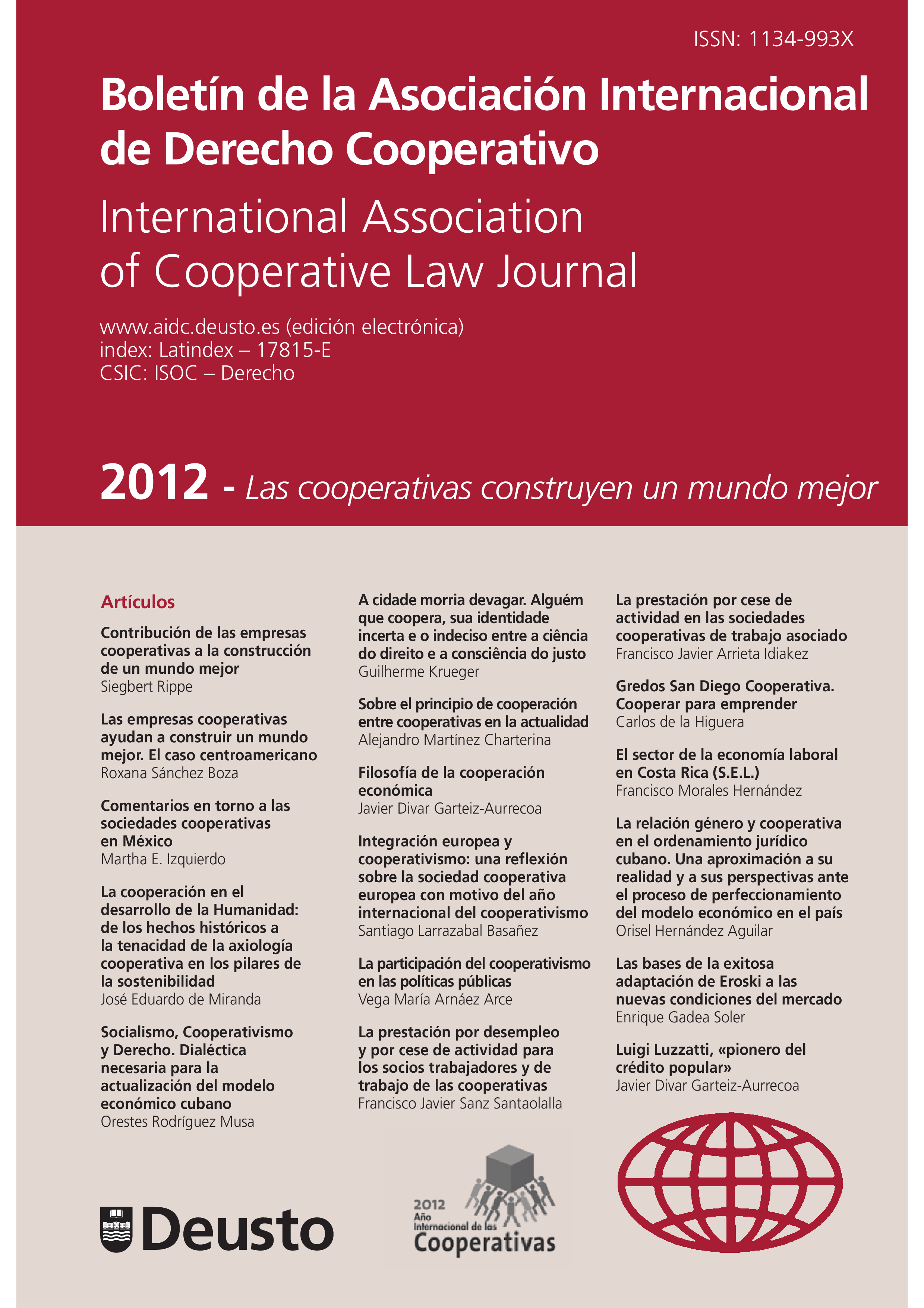
European integration and cooperativism: a reflection on European cooperative societies to mark the international year of cooperativism
Abstract
This study aims to make us aware of the importance that the spread of cooperatives has had on European integration, also approached from educational institutions and how their inspiring principles should penetrate more deeply into the «acquis communautaire» in the framework of this process. It offers an in-depth study of the endeavours made to this effect in the legal scope through Commission Regulation EC no. 1435/2003 of 22 July 2003, on the bylaws of European Cooperative Society (SCE) and Commission Directive 2003/72/EC of the same date, which completes the bylaws on European cooperatives concerning implications for workers. The study analyses the positive and negative points of this regulation and the implementation of the SCE from the time it started in 2003 to the present. It also proposes some measures to revitalise it, with the purpose of «socialising» the cooperative model in the process of European social integration, which is currently undergoing a severe crisis.
Received: 12 July 2012
Accepted: 10 September 2012
Published online: 18 December 2015
Downloads
Last update: 29/06/2026
The authors are advised to read their rights carefully. We believe this approach ensures a fair agreement for both parties. These instructions should be read in conjunction with the Ethical Guidelines and the Open Access Policy, Licensing Terms and Copyright of the journal "Boletín de la Asociación Internacional de Derecho Cooperativo (BAIDC)".
1. Authorship and Ethics
By submitting their manuscripts to Boletín de la Asociación Internacional de Derecho Cooperativo (BAIDC), the authors accept and undertake to comply with the conditions of publication without the need to sign an additional transfer agreement with the Publisher (University of Deusto). In doing so, they guarantee that their work is unpublished in any form, original, and does not breach BAIDC’s Ethical Guidelines or the rights of third parties, and that no licences have been or will be granted that are incompatible with the rights granted to the Publisher.
The authors assume full and exclusive responsibility for the content of the study and formally declare that they have no conflicts of interest that affect the integrity of the research.
2. Publisher’s Rights
By submitting the manuscript, the authors agree to its publication under the Creative Commons CC BY-NC-ND 4.0 licence. Consequently, they grant the Publisher the exclusive, royalty-free and worldwide right of first publication, editing, layout and exploitation of the article. This grant authorises the Publisher to distribute, sub-license and index the work in any format, medium, database or institutional repository, for the purposes of promotion and scientific dissemination.
3. Copyright
The authors retain the intellectual property rights to their article and retain the right to distribute and use their work for teaching purposes, future research or personal archiving, provided that the original publication in the Journal is cited. They are also permitted to republish in other media, provided that a (foot)note is included with the full reference to BAIDC (including the DOI, where available) and no explicit endorsement of the Journal and/or Publisher is implied.
4. Open access
BAIDC is an open-access journal; this means that it is freely and fully accessible in its entirety immediately upon publication of its content. However, in accordance with the licence mentioned above, the authors of the articles must always be properly cited; and both commercial use and any modification intended for distribution will require the express prior written permission of the rights holder.
More details are available under the section “Open Access Policy, Licensing Terms and Copyright”.
.jpg)
.jpg)
.jpg)
1.jpg)
.jpg)
.jpg)