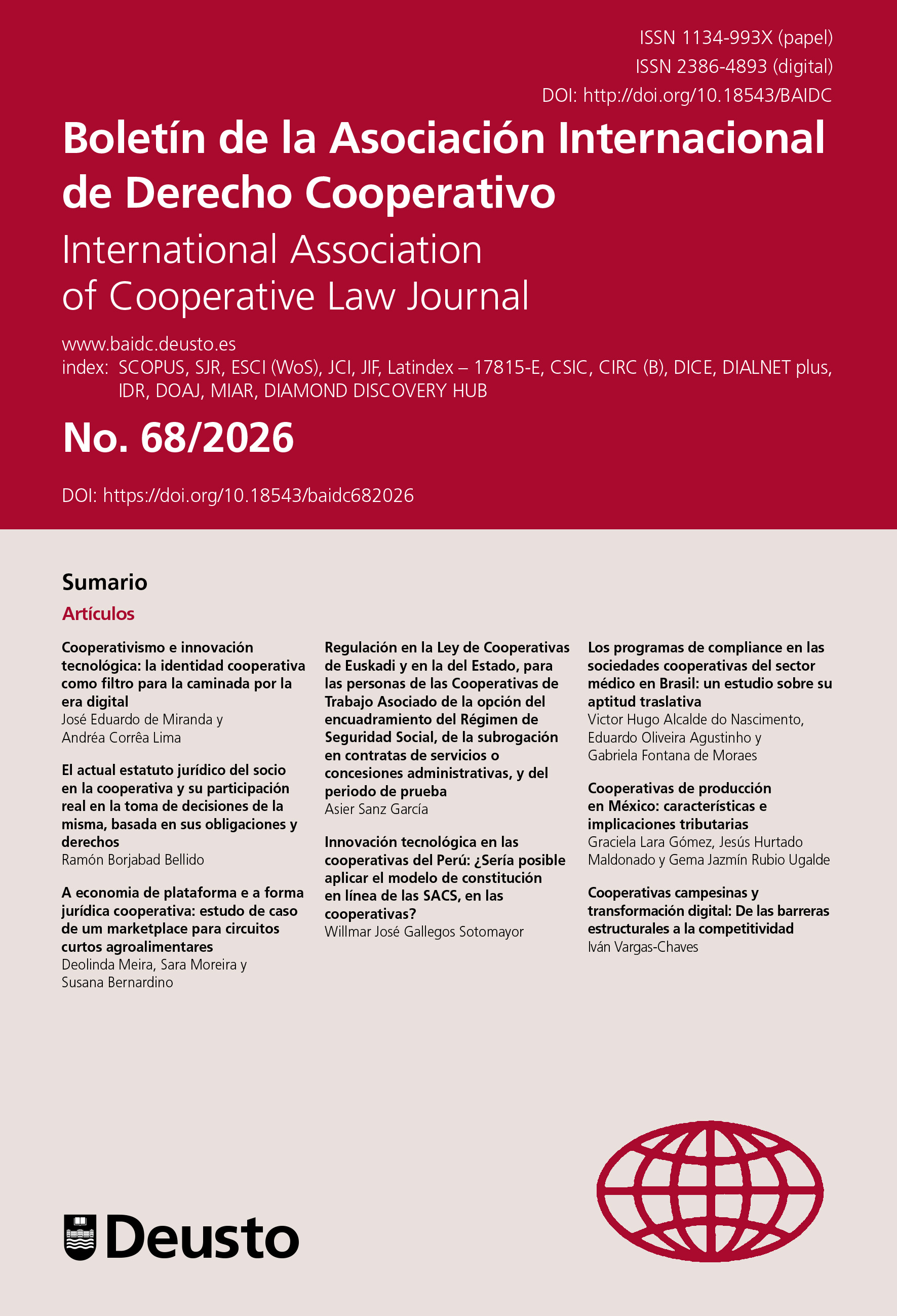
Regulation in the Basque Country Cooperatives Law and in the State Law
concerning the option of Social Security scheme classification, subrogation in service contracts or administrative concessions, and the probationary period for individuals in Worker Cooperatives
Abstract
Associated Labor Cooperative Societies enjoy great autonomy with regard to their internal operating rules, since they are self-managed by their members, and not through labor ties. In these entities, it is necessary to ensure the appropriate use of the Principle of Self-regulation by the working members, as well as that they carry out their work in an adequate and effective manner in accordance with the corporate purpose of the entity. In this work, a legal analysis has been carried out in accordance with Law 11/2019, of December 20, on Cooperatives of the Basque Country and Law 27/1999, of July 16, on Cooperatives, regarding the regulation in Law 11/2019, of December 20, on Cooperatives of the Basque Country and in Law 27/1999, of July 16, on Cooperatives, on the option of framing the Social Security Regime of Associated Work Cooperatives (in what successive CTA), of subrogation for working members in service contracts or administrative concessions, and of the trial period for working members, using jurisprudential and doctrinal pronouncements related to the subject of study. And finally, a series of legal conclusions are drawn on each of the matters analyzed in this article.
Received: 01 November 2025; Accepted: 08 April 2025
Downloads
References
CHARRO BAENA, Pilar. 2019. «Cooperativas de trabajo asociado». En: Memento práctico Francis Lefebvre – Sociedades Cooperativas, (coords. Campuzano, A.B., Enciso Alonso – Munumer, M., Molina Hernández, C.), Francis Lefebvre, Madrid, epig. 6800.
DE NIEVES NIETO, Nuria. 2005. «Cooperativas de Trabajo Asociado: Aspectos Jurídicos-Laborales», Consejo Económico y Social, Colección Estudios, núm. 175, Madrid.
GARCÍA JIMÉNEZ, Manuel. 2016. «Cooperativa de trabajo asociado y estatuto jurídico de sus socios trabajadores». En: Capítulo X. El concepto de cooperativa de trabajo asociado. Objeto social y principales características. (direc. FAJARDO GARCÍA, G., coord. SENENT VIDAL, M.J.), Tirant lo Blanch, Valencia, pp. 221-228.
LÓPEZ, GANDÍA, Juan. 2006. «Las cooperativas de trabajo asociado y la aplicación del derecho del trabajo», Tirant Lo Blanch, Madrid.
SANZ SANTAOLALLA, Francisco Javier. 2021. «Clases de cooperativas: Cooperativas de trabajo asociado» En: Glosa a la ley de cooperativas de Euskadi (coord.: Merino Hernández, S.), Consejo Superior de Cooperativas de Euskadi, Vitoria, pp. 365-394.
REAL DECRETO-LEY 28/2018, de 28 de diciembre, para la revalorización de las pensiones públicas y otras medidas urgentes en materia social, laboral y de empleo. (BOE núm. 314 de 29 de diciembre, de 2018).
LEY 27/1999, de 16 de julio, de Cooperativas. (BOE núm. 170 de 17 de julio, de 1999). op. cit.
LASSALETTA GARCÍA, Pedro J. 2010. «El acceso a la condición de socio en la sociedad cooperativa de trabajo asociado», Reus, Madrid.
REAL DECRETO-LEY 8/2015, de 30 de octubre, por el que se aprueba el texto refundido de la Ley General de la Seguridad Social. (BOE núm. 261 de 31 de octubre, de 2015).
COSTAS COMESANA, Julio. 2018. «Capítulo XVI Cooperativas de trabajo asociado ». En: Tratado de derecho de sociedades cooperativas, (coord.: Vázquez Ruano, T., direc.: Peinado Gracia, J.I.), 2 edición, Tirant lo Blanch, Valencia, pp. 1451-1508.
SANZ GARCÍA, Asier. 2024. «La regulación en la Ley 11/2019, de 20 de diciembre, de Cooperativas de Euskadi y en la Ley 27/1999, de 16 de julio, de Cooperativas, para las personas socias trabajadoras». Boletín de la Asociación Internacional de Derecho Cooperativo, n.º 63 (enero), 173-201. https://doi.org/10.18543/baidc.2847.
LEY 11/2019, de 20 de diciembre, de Cooperativas de Euskadi (BOPV núm. 247 de 30 de diciembre de 2019).
STSJ CL, n.º 635/2010, Sala de lo Social, Sección 1, 3 de noviembre de 2010. (ECLI:ES:TSJCL:2010:5616).
STS, n.º 974/2023, Sala de lo Social, Sección 1, 14 de noviembre de 2023 (ECLI:ES:TS2023:4767)
STSJ CL, n.º 668/2010, Sala de lo Social, Sección 1, 17 de noviembre de 2010. (ECLI:ES:TSJCL:2010:5915).
STSJ CLM, n.º 2910/2007, Sala de lo Contencioso, Sección 1, 29 de mayo de 2007. (ECLI:ES:TSJCL:2007:2910).

This work is licensed under a Creative Commons Attribution-NonCommercial-NoDerivatives 4.0 International License.
Last update: 29/06/2026
The authors are advised to read their rights carefully. We believe this approach ensures a fair agreement for both parties. These instructions should be read in conjunction with the Ethical Guidelines and the Open Access Policy, Licensing Terms and Copyright of the journal "Boletín de la Asociación Internacional de Derecho Cooperativo (BAIDC)".
1. Authorship and Ethics
By submitting their manuscripts to Boletín de la Asociación Internacional de Derecho Cooperativo (BAIDC), the authors accept and undertake to comply with the conditions of publication without the need to sign an additional transfer agreement with the Publisher (University of Deusto). In doing so, they guarantee that their work is unpublished in any form, original, and does not breach BAIDC’s Ethical Guidelines or the rights of third parties, and that no licences have been or will be granted that are incompatible with the rights granted to the Publisher.
The authors assume full and exclusive responsibility for the content of the study and formally declare that they have no conflicts of interest that affect the integrity of the research.
2. Publisher’s Rights
By submitting the manuscript, the authors agree to its publication under the Creative Commons CC BY-NC-ND 4.0 licence. Consequently, they grant the Publisher the exclusive, royalty-free and worldwide right of first publication, editing, layout and exploitation of the article. This grant authorises the Publisher to distribute, sub-license and index the work in any format, medium, database or institutional repository, for the purposes of promotion and scientific dissemination.
3. Copyright
The authors retain the intellectual property rights to their article and retain the right to distribute and use their work for teaching purposes, future research or personal archiving, provided that the original publication in the Journal is cited. They are also permitted to republish in other media, provided that a (foot)note is included with the full reference to BAIDC (including the DOI, where available) and no explicit endorsement of the Journal and/or Publisher is implied.
4. Open access
BAIDC is an open-access journal; this means that it is freely and fully accessible in its entirety immediately upon publication of its content. However, in accordance with the licence mentioned above, the authors of the articles must always be properly cited; and both commercial use and any modification intended for distribution will require the express prior written permission of the rights holder.
More details are available under the section “Open Access Policy, Licensing Terms and Copyright”.
.jpg)
.jpg)
.jpg)
1.jpg)
.jpg)
.jpg)